Journey progress
0/6 stops

Digestive System

A guided journey in six stops

Anatomy & Physiology • Histology Lab • Prof. Amy Fenwick

How to use this page

This journey covers the digestive system from mouth to anus, in six stops spread across one week. Each stop takes about 25–30 minutes and follows the same rhythm:

One topic per day:

Click any stop to expand. Progress is saved automatically in this browser.

Big-picture preview

Before diving into the six stops, take five minutes to map the whole tract — every organ from mouth to anus, plus the four accessory glands. The activity below is the reference picture for the rest of the week.

H5P ACTIVITY — Total GI tract & accessory organs
Loads live from bettybroadbent.com — needs an internet connection.
1 Mouth & Esophagus Day 1 (Mon) • ~30 min • Where digestion begins; the two stratified-squamous regions of the gut
Why this stop matters: The mouth and esophagus share one signature feature — stratified squamous epithelium — because they both deal with abrasion (chewing in the mouth, swallowing in the esophagus). Recognizing that lining is the first move in any "where am I?" decision on a slide.
TEXT

The work of the mouth

The mouth (oral cavity) is where digestion physically and chemically begins. Teeth break food into smaller pieces (mastication), the tongue manipulates the bolus, and three pairs of salivary glands moisten everything with saliva. Saliva is mostly water, but it also contains amylase (starts starch digestion), lingual lipase (starts fat digestion), lysozyme + IgA (antibacterial), and a buffering bicarbonate.

The mouth is lined by stratified squamous epithelium — same as your skin, but kept moist (non-keratinized) instead of dry. The hard palate and gums are partly keratinized because they take more abrasion; the cheeks and soft palate are non-keratinized.

Three pairs of salivary glandsall empty into the mouth
Parotid — almost entirely serous acini → watery, amylase-rich saliva. Mumps targets this gland.
Submandibularmixed: mostly serous with mucous tubules (capped by serous demilunes). Produces most of your resting saliva.
Sublingual — almost entirely mucous → thick, slimy saliva.
MICROGRAPH — Oral mucosa
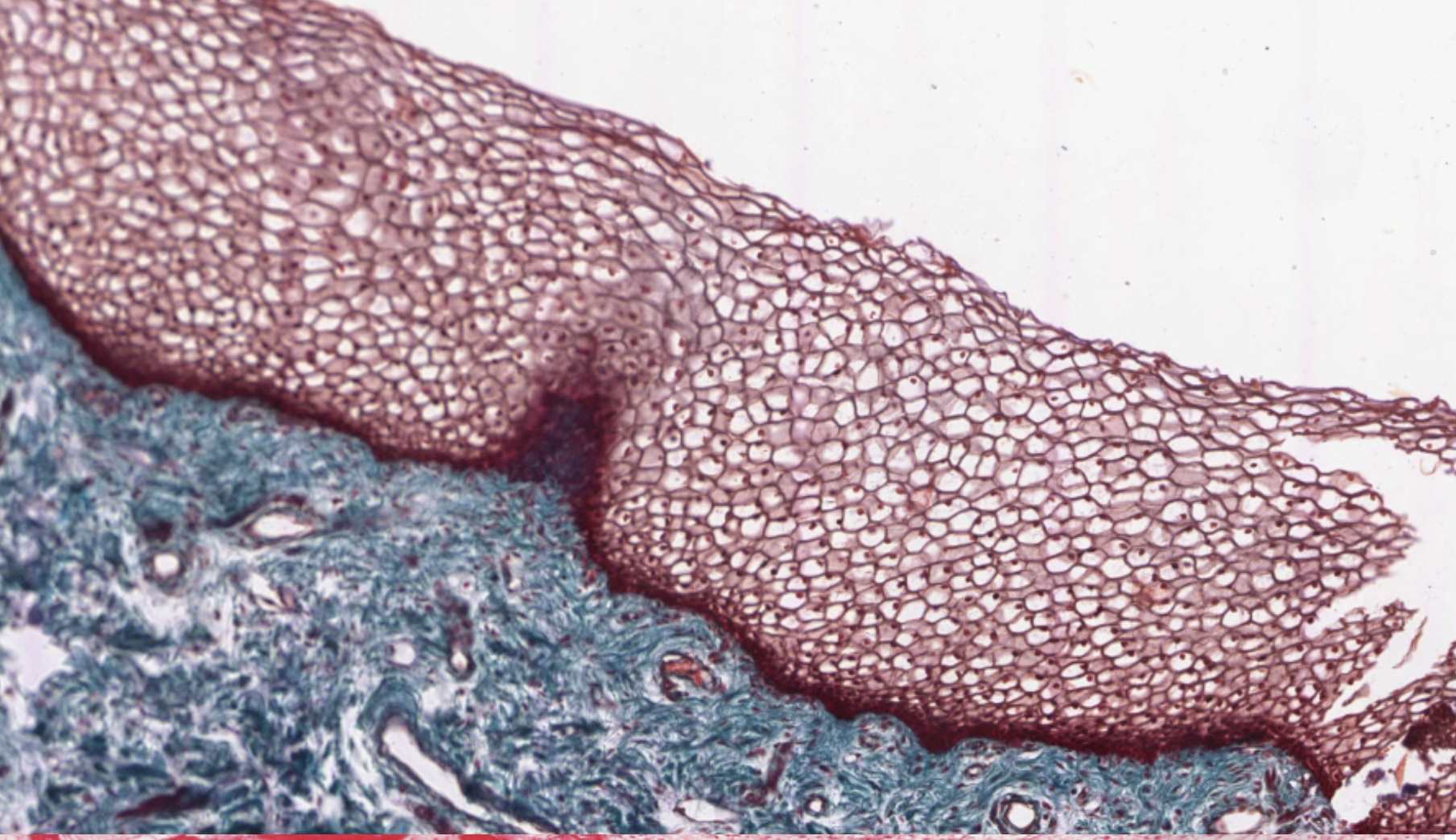
Oral mucosa H&E micrograph showing non-keratinized stratified squamous epithelium.
Non-keratinized stratified squamous epithelium with a thin keratinized surface in higher-friction zones — note the rete ridges where epithelium dips down into the lamina propria.

Epiglottis — the swallowing flap

Sitting at the boundary between the oral cavity and the esophagus, the epiglottis is a leaf-shaped flap that flips down over the laryngeal opening when you swallow, sending the bolus toward the esophagus instead of the trachea. Histologically it has a core of elastic cartilage (you can see the dense black-stained elastic fibers between chondrocytes) covered on both surfaces by stratified squamous epithelium that transitions to pseudostratified ciliated columnar on the laryngeal side.
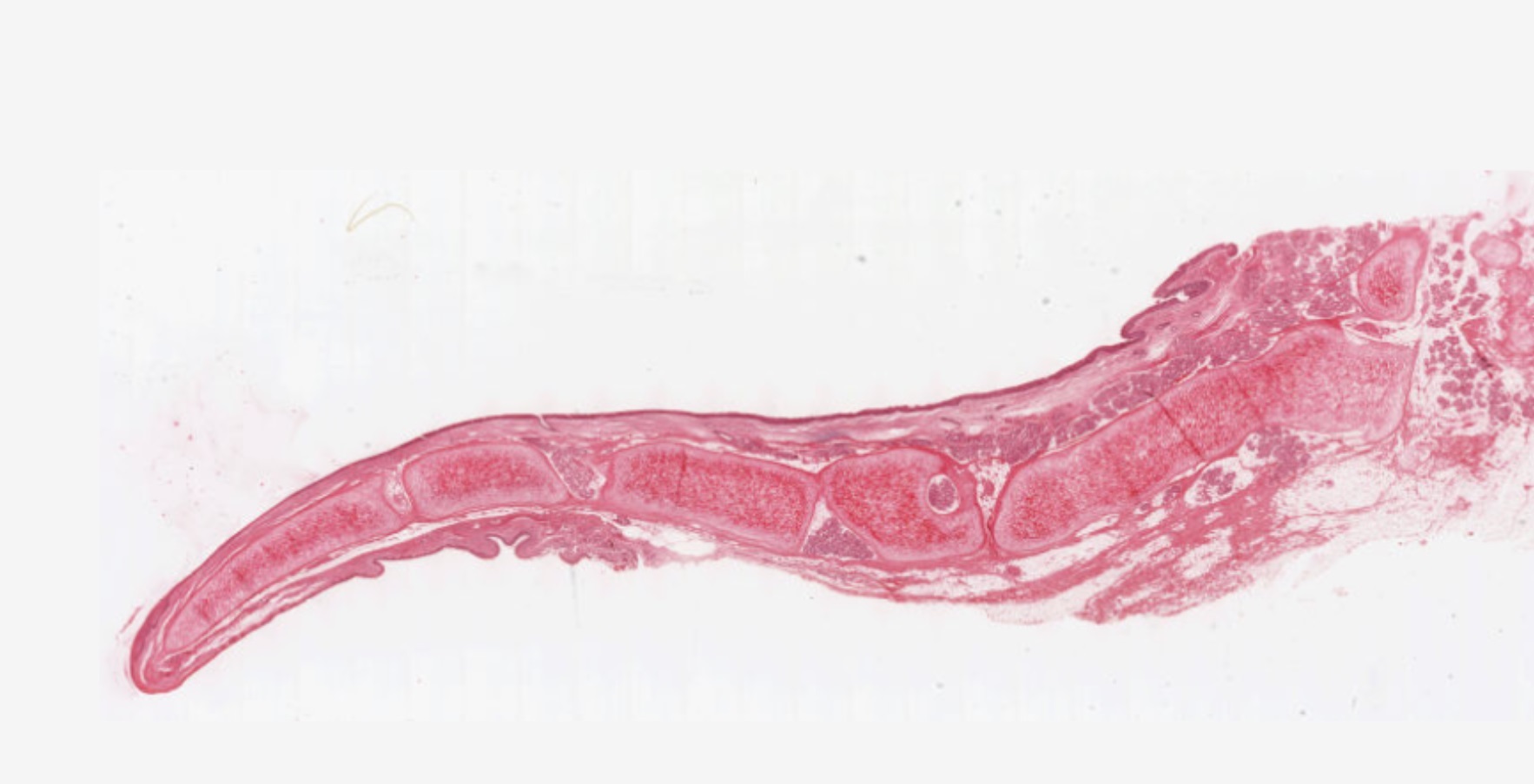
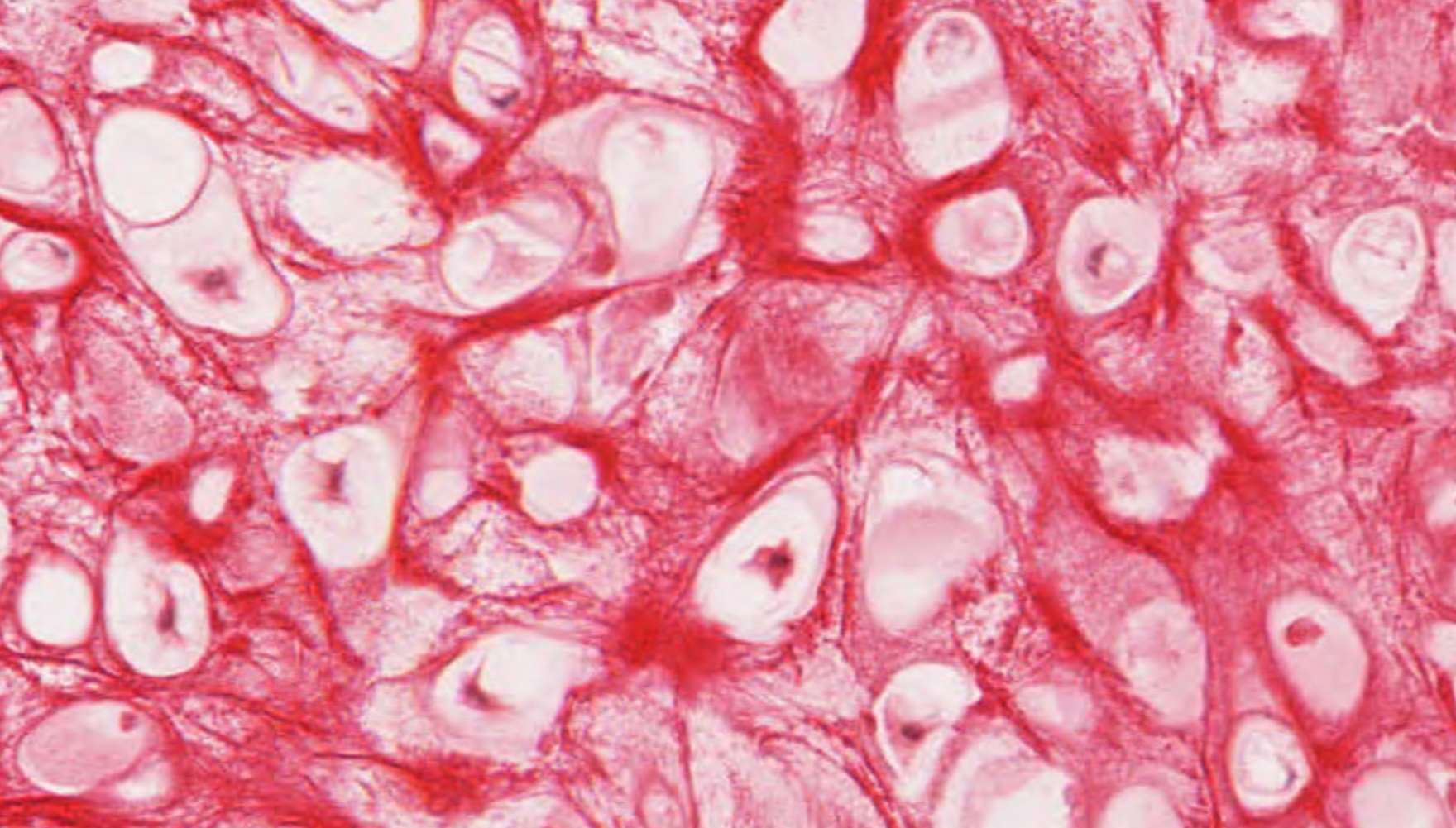
Epiglottis low magnification showing whole leaf shape, elastic cartilage core, and surface epithelium.
Low magnification — the whole leaf-shaped epiglottis with its elastic cartilage core.
Epiglottis high magnification showing elastic cartilage and chondrocytes.
High magnification — chondrocytes in elastic cartilage; black-stained elastic fibers in the matrix.

The esophagus — a tube built for the bolus

The esophagus is a 25 cm muscular tube from pharynx to stomach. It does not absorb anything; its only job is to move the bolus from mouth to stomach by peristalsis. So the histology is built around abrasion-resistance and lubrication:

  • Stratified squamous lining (same as the mouth — for abrasion).
  • Submucosal mucous glands — one of only TWO regions of the gut with submucosal glands (the other is duodenum's Brunner's glands). Their mucus lubricates the bolus.
  • Muscularis externa changes along its length: skeletal muscle in the upper third (you can choke yourself voluntarily), mixed in the middle, smooth muscle in the lower third.
  • Adventitia on the outside — NOT serosa! The esophagus is OUTSIDE the peritoneal cavity, so it gets a fibrous adventitia instead.
The gastroesophageal junctionan abrupt change of lining
At the cardia of the stomach, the lining changes ABRUPTLY from stratified squamous (esophagus) to simple columnar (stomach). On a slide this is a sharp visible transition. Acid reflux can damage this junction; chronic damage can lead to Barrett's esophagus, where stomach-style columnar epithelium creeps up into what should be esophagus.

Walking through the esophagus on a slide

MICROGRAPH — Esophagus submucosal mucous gland
Esophagus H&E showing a submucosal mucous gland.
A clear cluster of pale, mucus-secreting acini sitting in the submucosa. Submucosal glands are found in only TWO regions of the gut — esophagus (here) and duodenum (Brunner's). The mucus they produce flows through small ducts up onto the luminal surface to lubricate the bolus.

The myenteric (Auerbach) plexus. Between the inner circular and outer longitudinal layers of the muscularis externa runs the myenteric plexus — clusters of parasympathetic ganglia and nerve fibers belonging to the enteric nervous system. The myenteric plexus controls peristalsis: when you swallow, this plexus times the wave of muscle contractions that pushes the bolus down into the stomach. The enteric nervous system has more neurons than the entire spinal cord and can run digestive functions independently of the CNS — it is sometimes called the "second brain."

MICROGRAPH — Esophagus myenteric plexus
Esophagus H&E showing the myenteric (Auerbach) plexus between the inner circular and outer longitudinal smooth-muscle layers.
Look between the inner circular and outer longitudinal smooth-muscle layers — the small pale clusters of ganglion cells (large, round, with prominent nucleoli) are the myenteric plexus.
MICROGRAPH — Esophagus adventitia
Esophagus adventitia — the outermost fibrous CT layer.
The outermost layer is fibrous connective tissue — adventitia, NOT serosa — because the esophagus runs OUTSIDE the peritoneal cavity. It blends into the surrounding mediastinal CT instead of being wrapped by mesothelium.
INTERACTION

Click to reveal — the swallowing pathway

The first place food (and air) crosses paths is the upper aerodigestive tract. Try to name each numbered structure on the diagram below before clicking the blank to reveal the answer.

Sagittal head section showing nasal cavity, palate, tongue, pharynx, epiglottis, esophagus, trachea.
  • 1click to revealNasal cavity
  • 2click to revealHard palate
  • 3click to revealTeeth
  • 4click to revealTongue
  • 5click to revealPharynx
  • 6click to revealEpiglottis
  • 7click to revealEsophagus
  • 8click to revealTrachea
H5P ACTIVITY — Image Hotspots: Esophagus four-layer cross-section
Loads live from bettybroadbent.com.
CONFIRMATION

Quick self-check

What kind of epithelium lines the esophagus?
Stratified squamous (non-keratinized) — same as your skin, kept moist. It handles the abrasion of swallowed food.
Which salivary gland is almost entirely serous (watery, amylase-rich)?
Parotid = mostly serous. Sublingual = mostly mucous. Submandibular = mixed.
The esophagus has __________ on its outside (not serosa).
Adventitia — fibrous CT. The esophagus is OUTSIDE the peritoneal cavity, so it does not get serosa.
2 Stomach Day 2 (Tue) • ~25 min • The bag where chemical digestion ramps up
Why this stop matters: The stomach is where the lining switches to simple columnar AND immediately specializes into pits and glands packed with three diagnostic cell types: parietal (HCl), chief (pepsinogen), and G (gastrin). Knowing those three by sight is a high-yield exam skill.
TEXT
H5P ACTIVITY — Image Hotspots: Stomach
Loads live from bettybroadbent.com.

What the stomach actually does

The stomach is a J-shaped sac with three jobs: mechanical mixing (it churns), chemical digestion (HCl + pepsin), and storage (it lets you eat a meal in 15 minutes and digest it over hours). It also kills most swallowed bacteria thanks to its pH of 1.5–2.

The lining changes immediately at the gastroesophageal junction from stratified squamous to simple columnar, and that simple columnar surface dives down into millions of gastric pits. Below each pit, a deeper gastric gland is packed with the cells that do the real work.

Parietal cellsHCl + intrinsic factor
Large, ROUND, eosinophilic (PINK) cells. They sit in the upper-middle part of the gland. They secrete HCl (the stomach's acid) AND intrinsic factor, which the ileum needs in order to absorb vitamin B12. Lose your parietal cells (e.g., autoimmune atrophic gastritis) and you eventually get pernicious anemia.
Chief cellspepsinogen
Smaller, basophilic (BLUE), with basal nuclei. They live in the bottom of the gland. They secrete pepsinogen — the inactive precursor of pepsin. HCl from parietal cells activates pepsinogen → pepsin, which then digests proteins.
G cellsthe hormone gastrin
In the pyloric region. They're enteroendocrine — they secrete gastrin into the bloodstream, which then circles back and tells parietal cells to make more HCl. So when you smell food, gastrin goes up → acid goes up → digestion is ready.

Note: the stomach's muscularis externa is unique — it has three layers of smooth muscle (an extra inner oblique layer below the usual circular and longitudinal). This is what lets it churn so vigorously.

INTERACTION

Compare cell composition: body region vs. pyloric region

The same simple columnar surface lines the whole stomach, but the cells underneath the pits change as you move from body to pylorus. Use the diagram below to compare the two regions side by side.

Comparison of stomach body region vs. pyloric region cell composition.
Stomach body (parietal + chief cells) vs. pyloric region (mostly mucous + G cells).
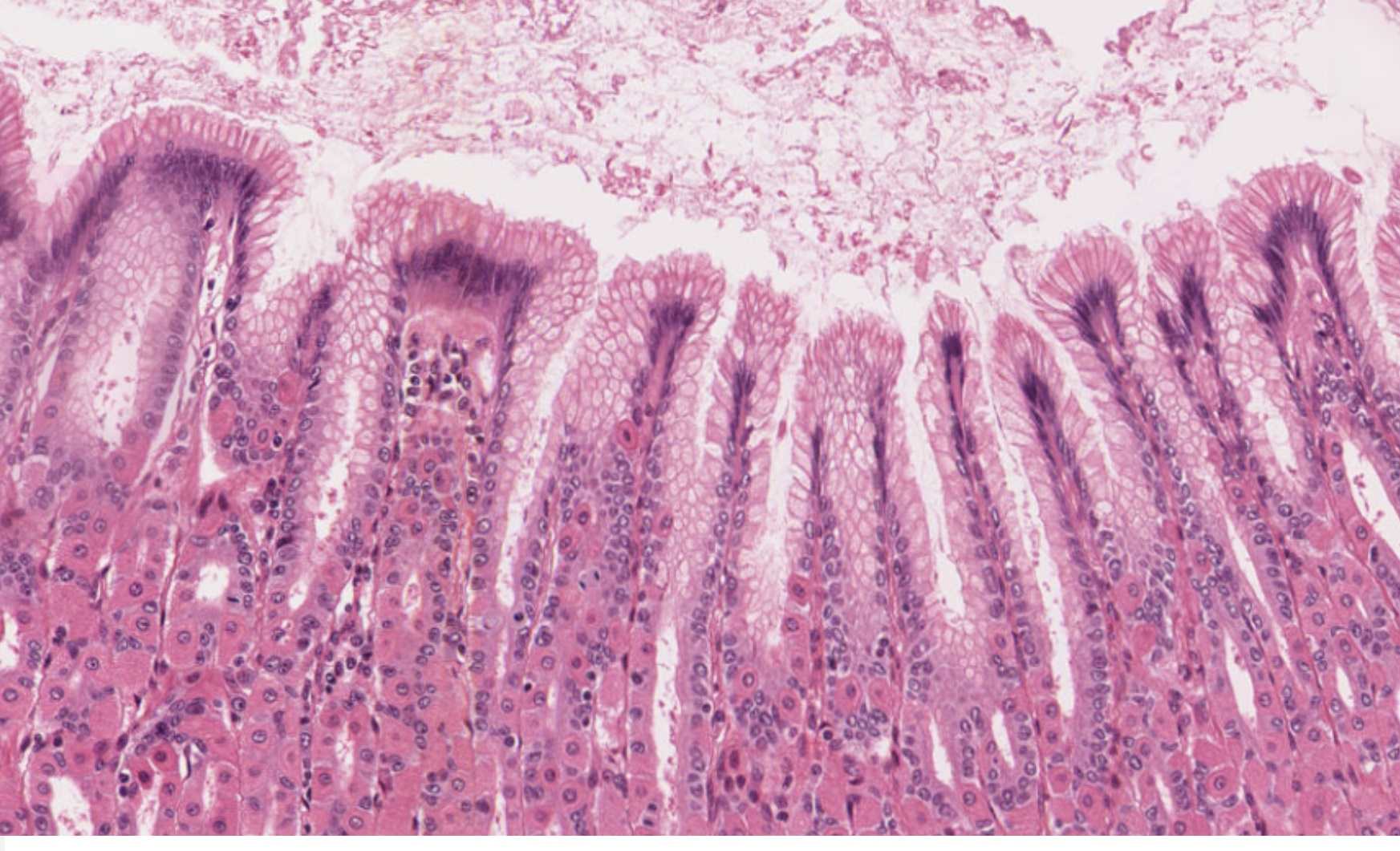
MICROGRAPH — Stomach mucosa
Stomach mucosa H&E micrograph showing pits, glands, parietal and chief cells.
Pits, glands, parietal cells (large pink), and chief cells (smaller blue) all visible.
CONFIRMATION

Quick self-check

Which cell makes HCl and intrinsic factor?
Parietal cell — large, round, PINK (eosinophilic). Intrinsic factor is what lets your ileum absorb B12.
Which cell makes pepsinogen?
Chief cell — smaller, BLUE (basophilic), basal nuclei, sitting at the bottom of the gland.
Why does the stomach have THREE layers of muscularis externa?
An extra inner oblique layer (in addition to the usual circular and longitudinal) lets the stomach churn forcefully and mix food in all directions.
A patient has lost their parietal cells from autoimmune attack. Which deficiency develops over time?
No parietal cells → no intrinsic factor → ileum cannot absorb B12 → pernicious (megaloblastic) anemia. (You also lose stomach acid, which can lead to indirect iron malabsorption too.)
3 Small Intestine Day 3 (Wed) • ~30 min • Where almost all nutrient absorption happens
Why this stop matters: The small intestine is the most-tested GI region. You need to recognize villi at low power, then tell duodenum from jejunum from ileum using ONE feature each. This stop builds that decision tree.
TEXT
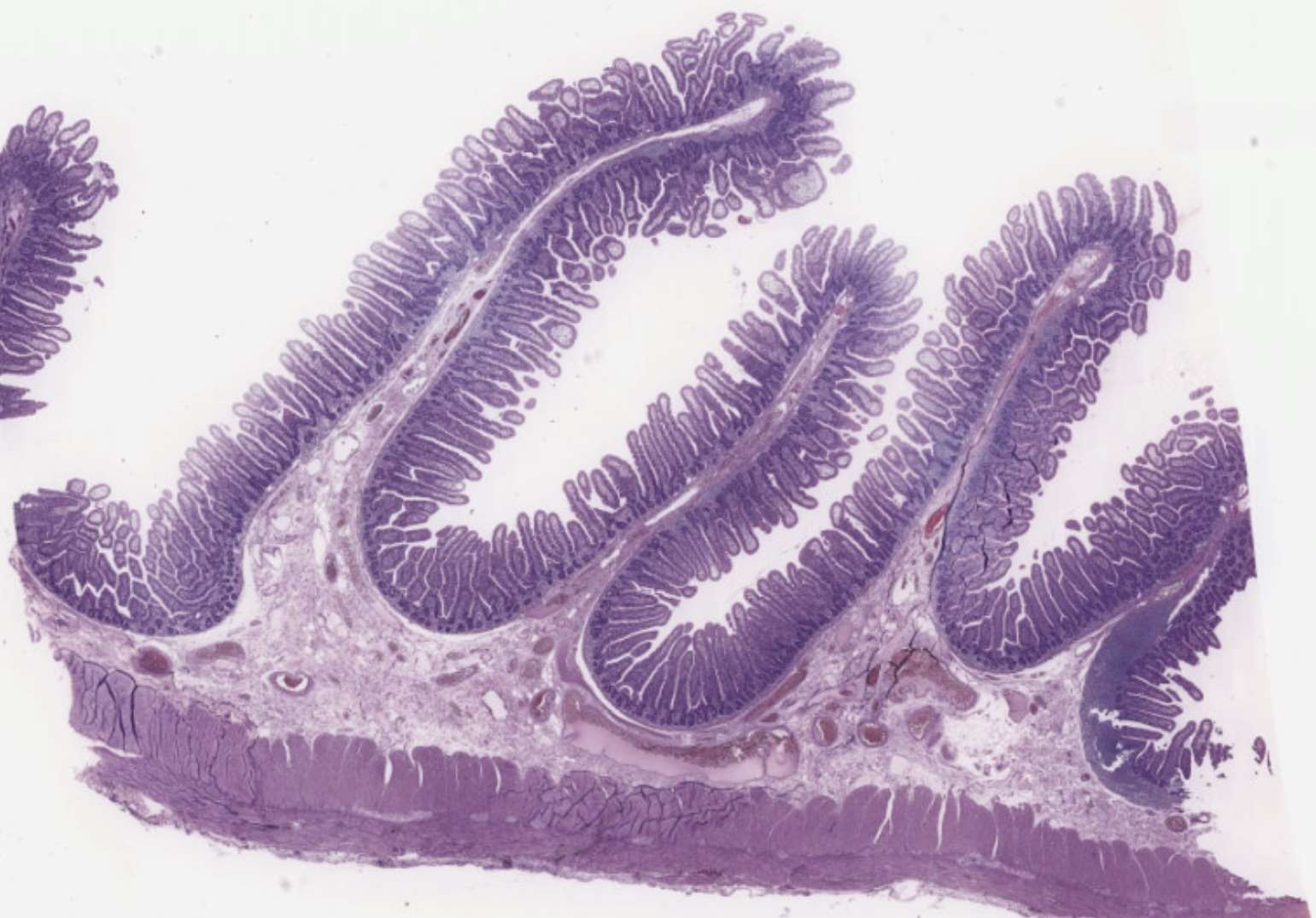
MICROGRAPH — Jejunum cross-section, low power, H&E
Jejunum cross-section showing plicae circulares and villi.
Plicae circulares + tall villi (jejunum's signature look).
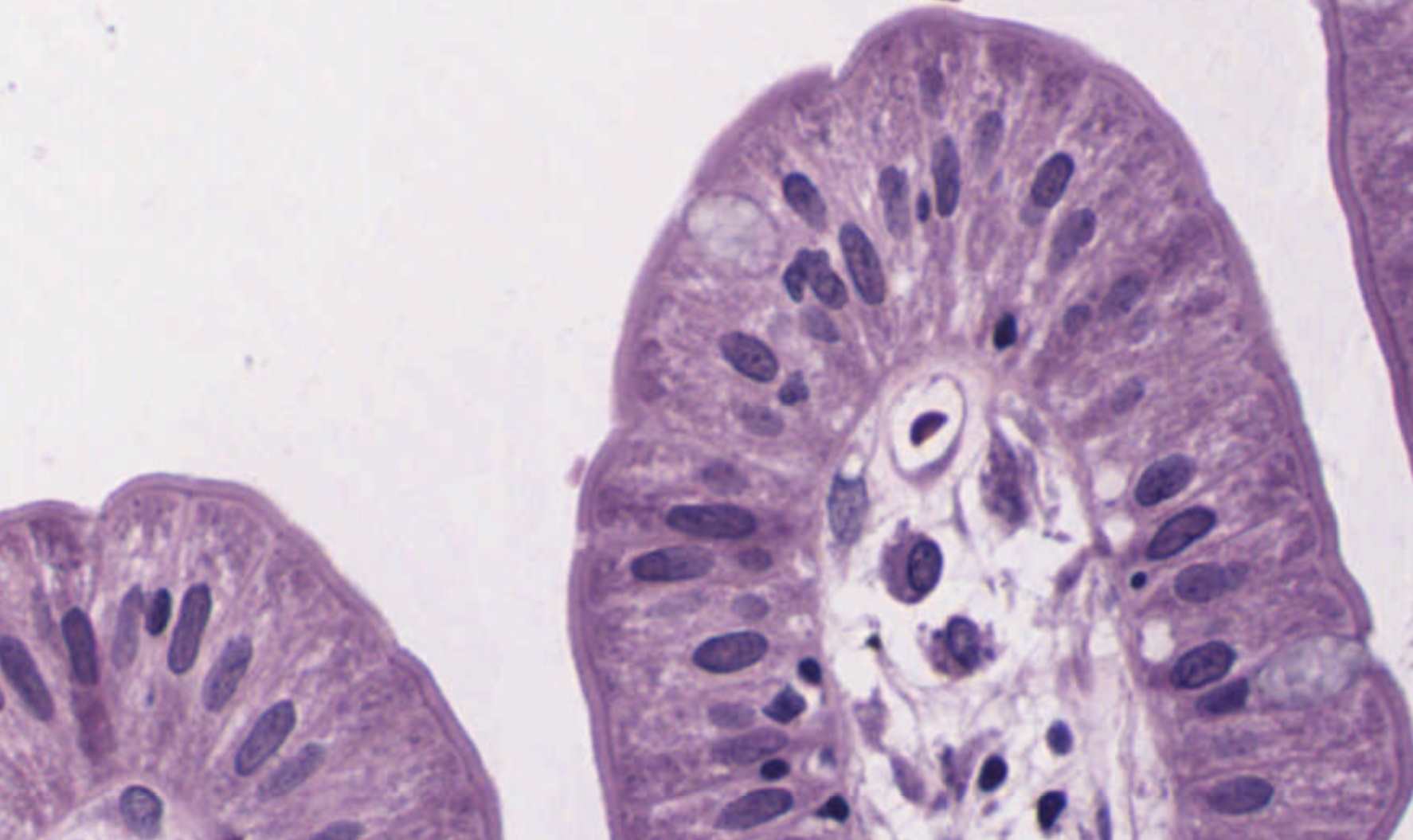
Jejunum cross-section, second view.
Same region, different field — confirms tall villi and absence of Brunner's / Peyer's.

Three levels of surface amplification

To absorb 95% of your day's calories, the small intestine multiplies its surface area roughly 600× over a smooth tube. It does this with three nested levels of folding:

  • Plicae circulares — naked-eye circular folds (mucosa + submucosa).
  • Villi — finger-like mucosa-only projections (visible at low microscope power).
  • Microvilli — the brush border. Only visible by EM, but you can see the fuzzy edge of the apical surface in LM.

Each villus has a central capillary bed (where most absorbed nutrients go into blood) and a single lacteal — a lymphatic capillary that absorbs fats as chylomicrons.

Telling the three subregions aparttwo features do all the work
Duodenum — has Brunner's glands in the SUBMUCOSA (alkaline mucus to neutralize acid chyme from the stomach). The only place in the gut other than esophagus with submucosal glands.

Jejunum — has neither Brunner's nor Peyer's. The "plain" middle subregion. Tallest villi, most plicae circulares.

Ileum — has Peyer's patches: large lymphoid follicles spanning lamina propria AND submucosa. (Bonus stop has more on this.) Comparison of duodenum, jejunum, and ileum showing diagnostic features.
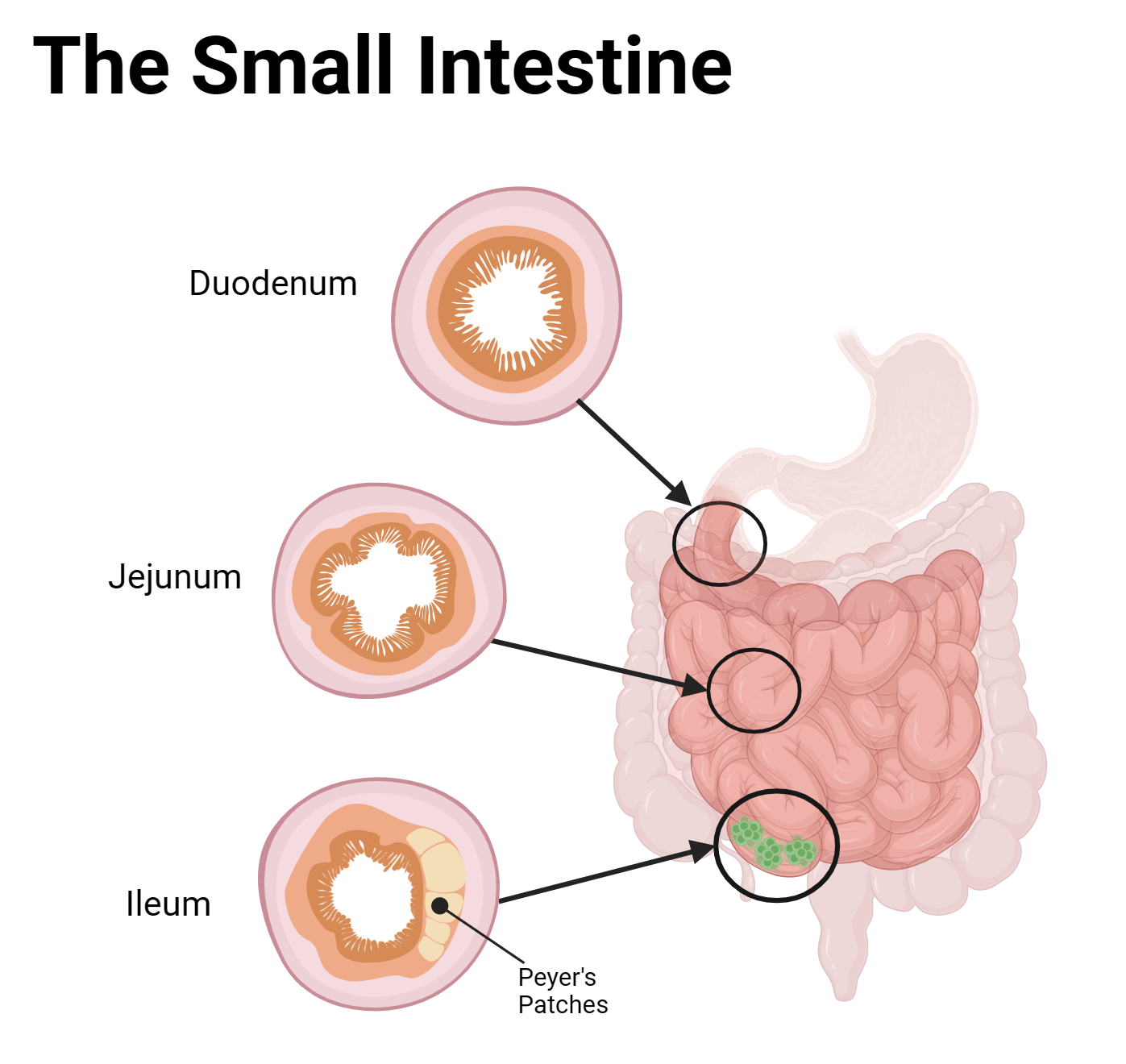
Side-by-side: duodenum (Brunner's), jejunum (plain), ileum (Peyer's).
Crypts of Lieberkühnwhere the epithelium regenerates
Tubular glands BETWEEN the villi. At the base of each crypt are stem cells (which regenerate the entire epithelium every 3–5 days) and Paneth cells (eosinophilic granules; secrete antimicrobial defensins and lysozyme — innate immunity). Above them, more stem cell daughters mature as they migrate UP the villus.
INTERACTION

Look at the real tissue

H5P ACTIVITY — Image Hotspots: Small Intestine
Loads live from bettybroadbent.com.
Small intestine accessory image.
CONFIRMATION

Quick self-check

From COARSEST to FINEST surface amplification:
Plicae are naked-eye macroscopic folds. Villi are LM-visible finger projections (much smaller). Microvilli are EM-only brush border.
A small intestine cross-section shows submucosal mucous glands. This is:
Brunner's glands = submucosal mucous glands → DUODENUM. They neutralize the acid chyme arriving from the stomach.
Cells at the BOTTOM of the crypts that secrete antimicrobial defensins are:
Paneth cells live at the BOTTOM of crypts of Lieberkühn. Eosinophilic granules. Innate immunity.
Dietary fats absorbed at the villus enter:
Fats are packaged into chylomicrons and enter the LACTEAL (lymphatic capillary in the core of the villus). They eventually reach the bloodstream via the thoracic duct.
4 Large Intestine, Rectum & Anus Day 4 (Thu) • ~25 min • Water reabsorption + storage; the no-villi region
Why this stop matters: The large intestine is the easiest GI organ to misidentify. Students see "simple columnar with crypts" and call it small intestine — but the FLAT surface (no villi!) and the heavy goblet cells are diagnostic. Get those two features locked in.
TEXT

What the colon actually does

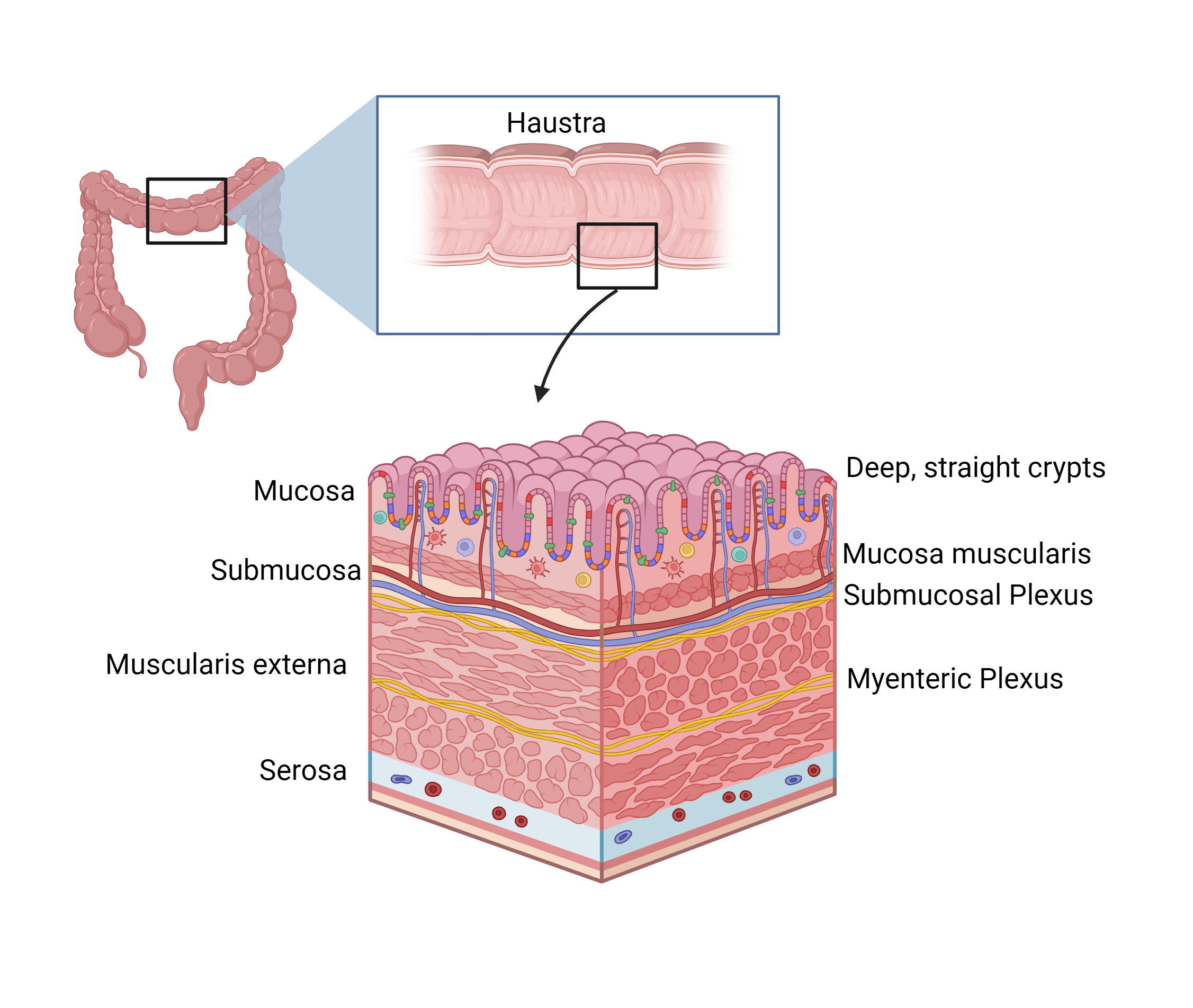
By the time material reaches the cecum, almost all the calories are gone. The large intestine has only TWO jobs left: reabsorb water (turning watery chyme into solid stool) and store the residue until you can find a bathroom. So the histology drops the absorptive bells and whistles:

  • FLAT mucosal surface — no villi (the most-missed exam point).
  • Deep, straight crypts packed with goblet cells. The mucus they make lubricates feces.
  • NO Paneth cells (the colon doesn't need them — it's already a thick microbial environment).
  • The outer longitudinal muscle is concentrated into THREE thick bands — the taenia coli. Their tonic contraction creates the pouches called haustra.
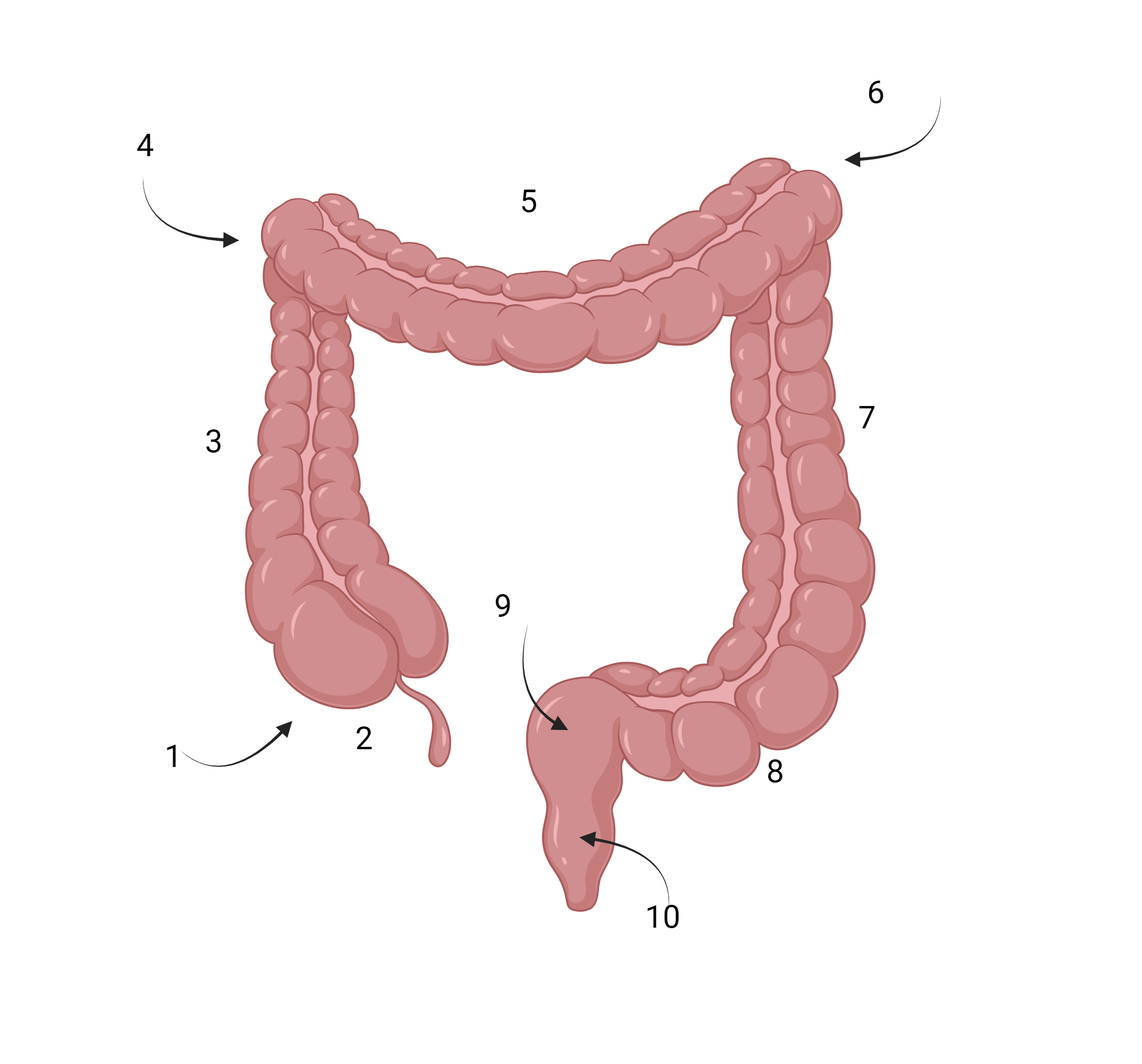
The frame of the colonhow it sits in your abdomen
Cecum (with the appendix hanging off) → ascending colon (right side) → hepatic flexure (under the liver) → transverse colon (across the top) → splenic flexure (under the spleen) → descending colon (left side) → sigmoid colon (S-shape) → rectumanal canal → anus. The colon literally frames the small intestine.
Large intestine click-to-reveal reference image.
  • 1click to revealCecum
  • 2click to revealAppendix
  • 3click to revealAscending colon
  • 4click to revealHepatic flexure
  • 5click to revealTransverse colon
  • 6click to revealSplenic flexure
  • 7click to revealDescending colon
  • 8click to revealSigmoid colon
  • 9click to revealRectum
  • 10click to revealAnal canal
The anal canal — TWO different liningssimple columnar above, stratified squamous below
The upper anal canal is continuous with the rectum (simple columnar). The lower anal canal switches BACK to non-keratinized stratified squamous because of the abrasion of defecation. The transition is the pectinate (dentate) line. This is also a clinical watershed: cancer above the line drains differently from cancer below it.
Large intestine accessory image — colon, rectum, anus reference.
INTERACTION

Real tissue — colon mucosa & submucosa
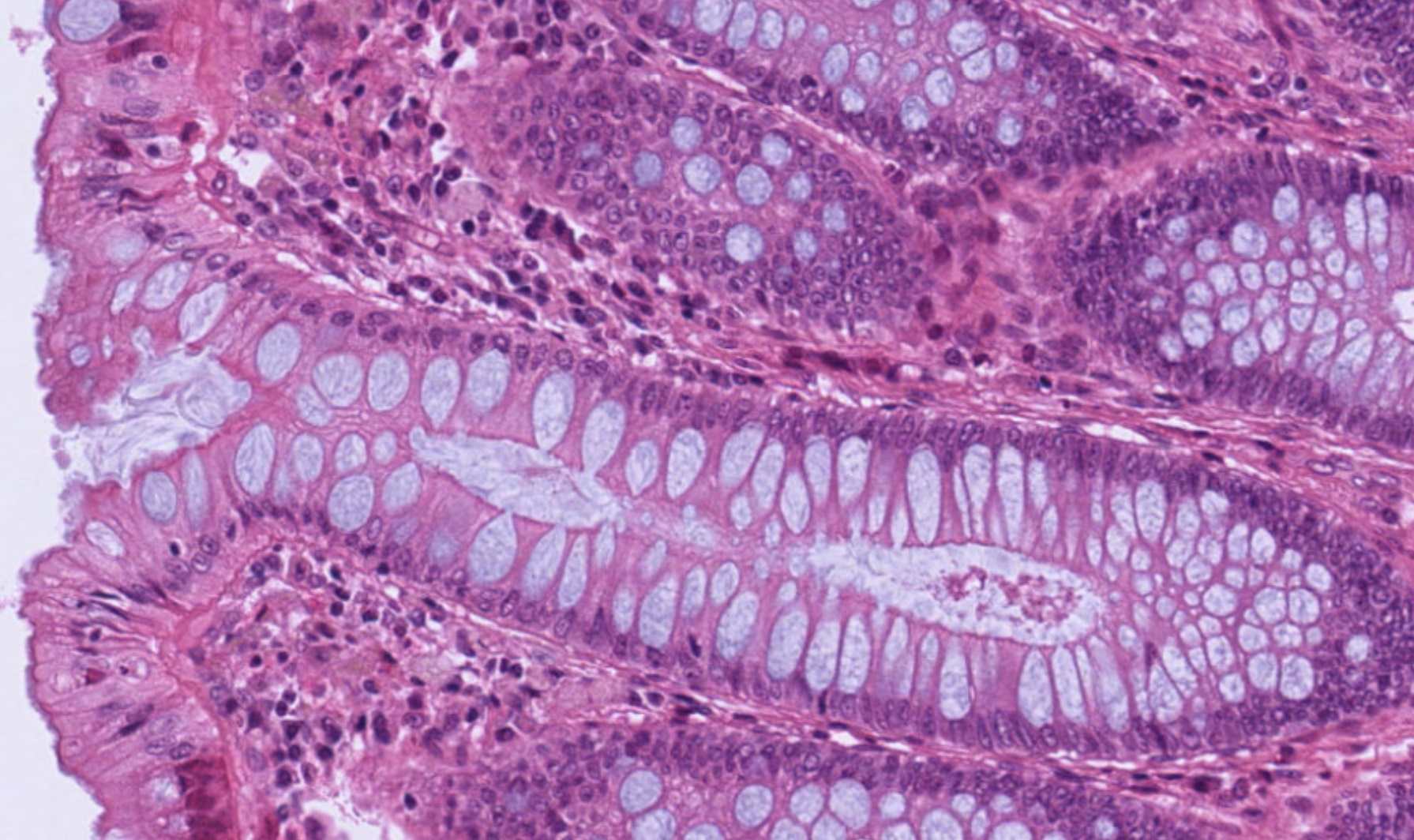
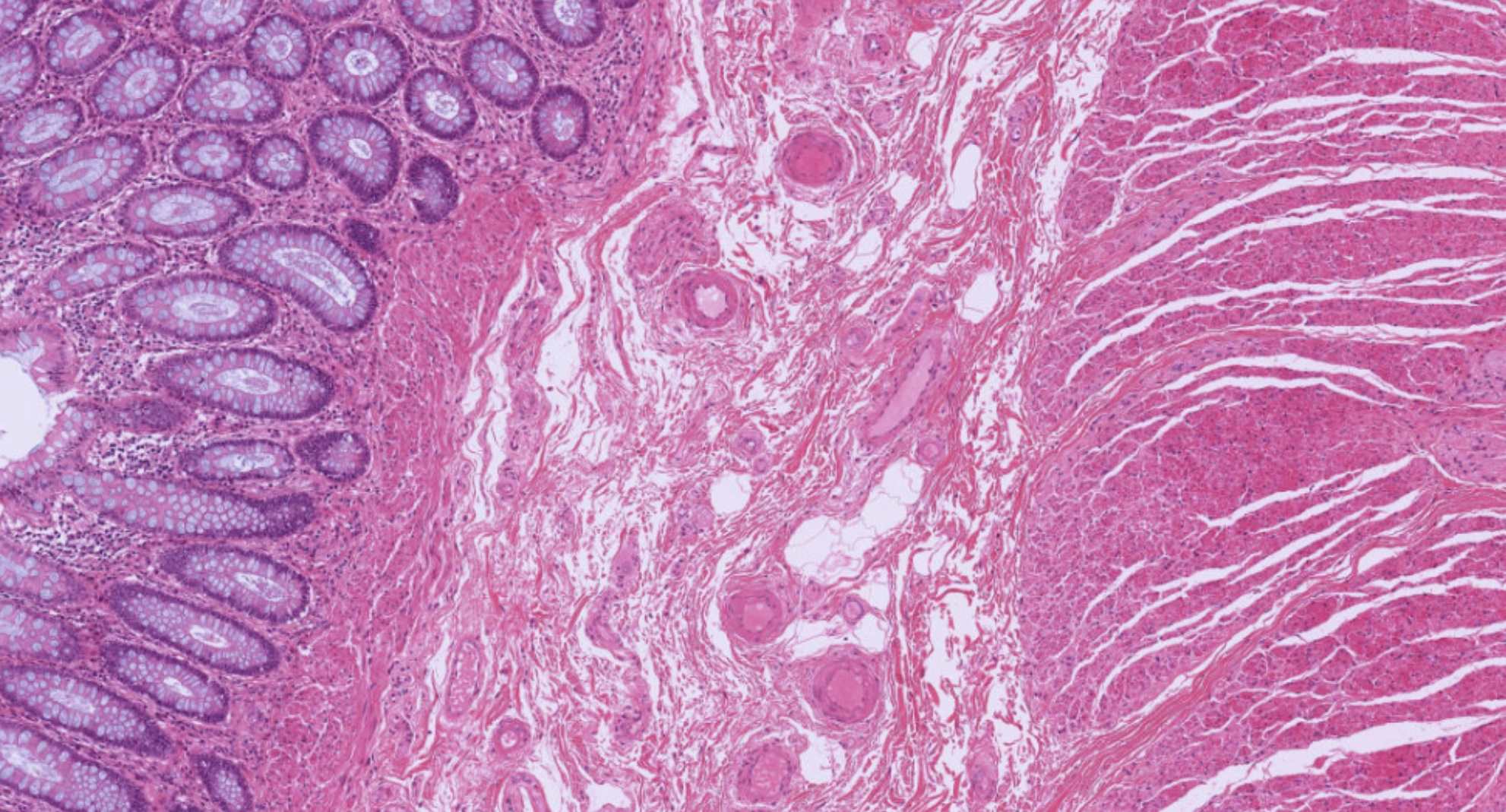
MICROGRAPH — Colon mucosa
Colon mucosa H&E showing flat surface, deep straight crypts, abundant goblet cells.
Flat luminal surface (no villi), deep straight crypts of Lieberkühn, abundant clear goblet cells lining the crypts.
MICROGRAPH — Colon submucosa
Colon submucosa H&E showing loose CT, vessels, and lymphatics.
Loose CT layer beneath the muscularis mucosae — note the vessels and scattered lymphocytes. NO submucosal glands here (those are exclusive to esophagus and duodenum).
[ INSERT MICROGRAPH ]
Anorectal junction — abrupt simple columnar → stratified squamous transition (pectinate line).
CONFIRMATION

Quick self-check

What's the FASTEST way to tell colon from small intestine on a slide?
Villi are diagnostic of small intestine. Colon has a FLAT surface — that's the giveaway.
The three thick longitudinal muscle bands on the outside of the colon are called:
Taenia coli — three bands. Their tonic contraction creates the pouches (haustra).
Lower anal canal lining is:
Lower anal canal switches BACK to stratified squamous because of the abrasion of defecation. The pectinate line marks the transition.
5 Accessory Glands Day 5 (Fri) • ~30 min • Salivary, pancreas, liver, gallbladder
Why this stop matters: Each accessory gland has a textbook-recognizable signature. Memorizing those four signatures (mixed acini / dark acini + pale islet / hexagonal lobule + central vein / tall folds without submucosa) lets you call all four at low power, no slide guesswork.
TEXT

The four accessory glands at a glance

Four organs empty into the digestive tract but are not part of the tube itself: the salivary glands (into the mouth) and the pancreas, liver, and gallbladder (all into the duodenum). The pancreas and gallbladder ducts often join to form the hepatopancreatic ampulla just before they empty.
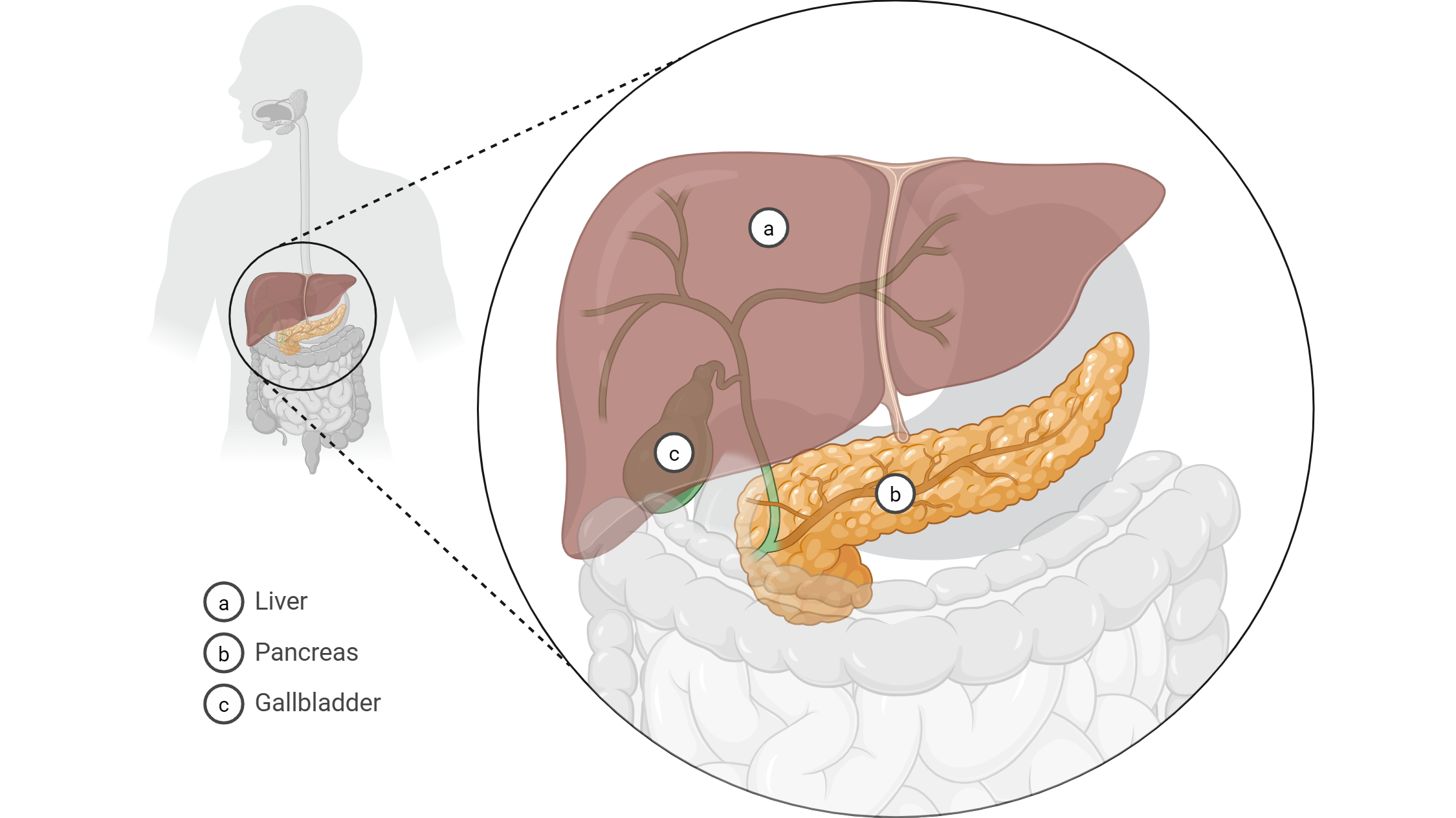
Overall anatomy of pancreas, liver, gallbladder, and their ducts emptying into the duodenum.
Gross anatomy of the accessory organs (pancreas, liver, gallbladder) and their ducts converging at the duodenum.
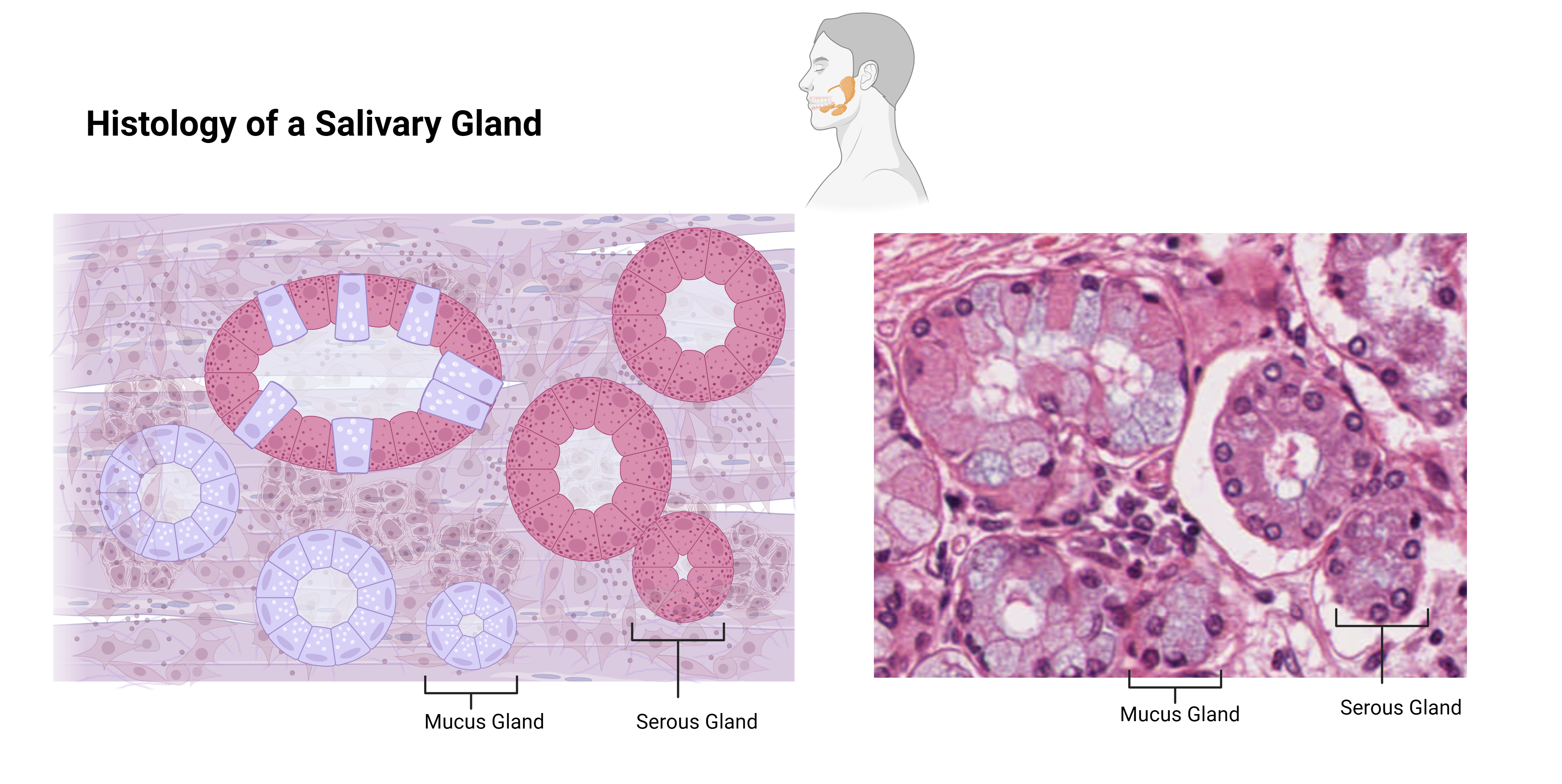
Salivary glands — mixed acinitwo acinus colors in one field
Look for a mix of DARK round serous acini and PALE tubular mucous acini in the same low-power field. Parotid is almost all serous; sublingual is almost all mucous; submandibular is mixed. Saliva contains amylase (starch), lingual lipase (fat), lysozyme + IgA (antibacterial), and mucus. Salivary gland histology — mixed serous and mucous acini.
Salivary gland — note the two acinus colors in the same field.
Pancreas — acini + ISLETSthe only organ that's both endocrine and exocrine
Looks like salivary at first — dark acini everywhere. The deal-breaker: a single PALE round Islet of Langerhans. Islets are endocrine (insulin from β cells, glucagon from α cells); acini are exocrine (digestive enzymes into ducts → duodenum). If you see one islet, you know it's pancreas. Pancreas histology — dark exocrine acini surrounding a pale Islet of Langerhans.
Pancreas — find the pale round islet in the sea of dark acini.
Liver — hexagonal lobulescentral vein in middle, portal triad at corners
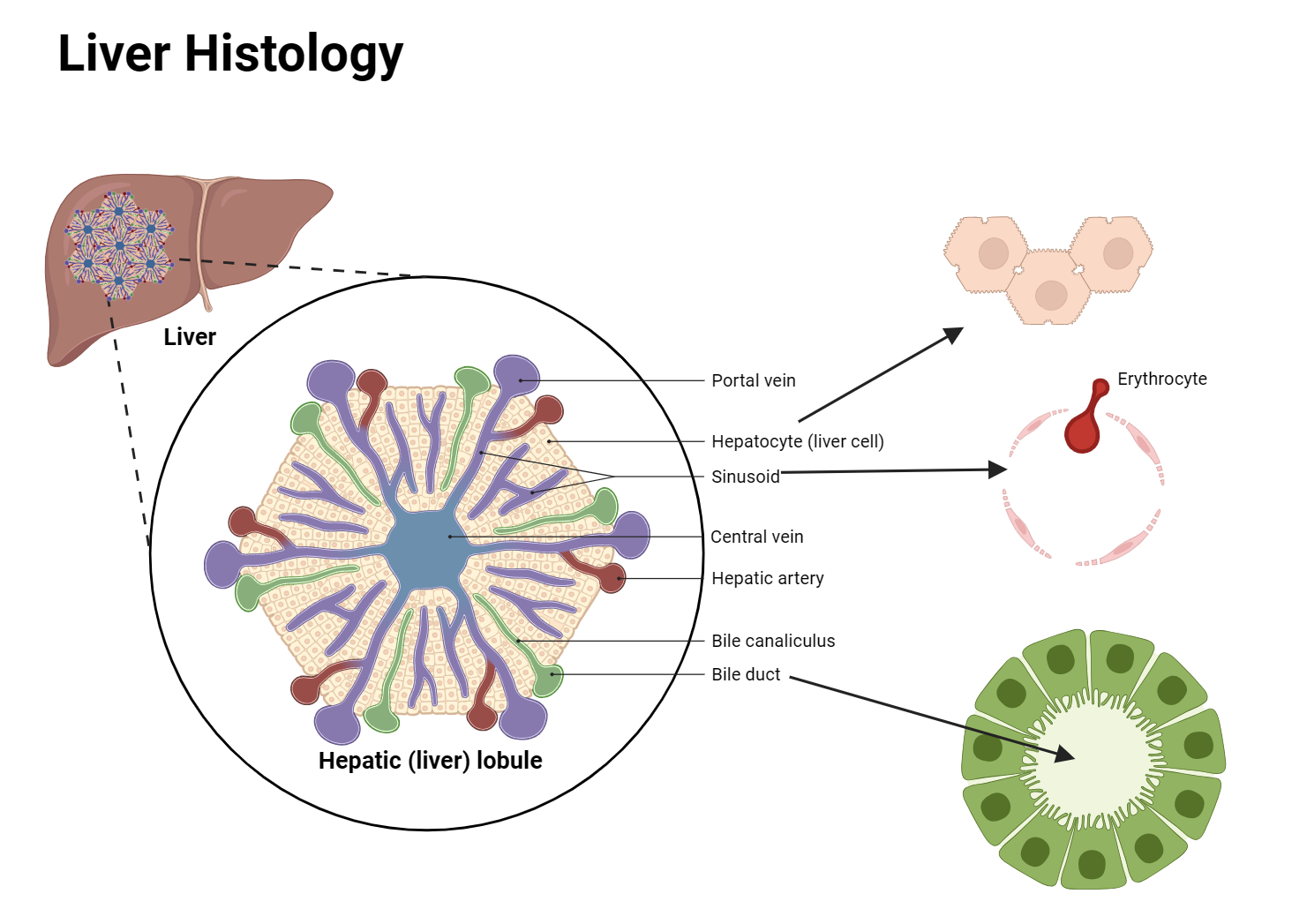
The liver is built from hexagonal LOBULES, each ~1 mm across. At the center: ONE thin-walled central vein. At each of the six corners: a portal triad — three vessels (bile duct, branch of portal vein, branch of hepatic artery). Hepatocytes radiate outward in plates with sinusoids between them. Blood travels INWARD from triad to central vein; bile travels OUTWARD through bile canaliculi to the bile duct in the triad. Liver histology view 1.
Liver lobule — central vein in the middle.
Liver histology view 2.
Liver — hepatocyte plates and portal triad at a corner.
Gallbladder — folds without submucosastores and concentrates bile
Tall mucosal folds (collapsed when empty), simple columnar epithelium, NO submucosa (the mucosa sits directly on the muscularis), thin smooth-muscle wall, serosa. It can hold ~50 mL of concentrated bile. After cholecystectomy, bile flows continuously rather than as a concentrated bolus — patients can still digest fats, just less efficiently.
CONFIRMATION

Quick self-check

At low power, you see a sea of dark acini AND a single pale round island. This is:
The PALE round island is an Islet of Langerhans → pancreas. Salivary glands NEVER have islets.
In a hexagonal liver lobule, the structure in the very CENTER is the:
Single thin-walled vessel in the middle = central vein. Three vessels at each corner = portal triad.
Which gland has NO submucosa, with mucosa sitting directly on the muscularis?
Gallbladder is unique. Tall mucosal folds + simple columnar lining + no submucosa.
Which salivary gland is mostly mucous (thick, slimy saliva)?
Sublingual = mostly mucous. Parotid = mostly serous (watery, amylase-rich). Submandibular = mixed.
6 BONUS — Immune Structures (GALT/MALT) Weekend (extra) • ~25 min • Adenoids, MALT, appendix, and Peyer's patches
Why this stop matters: The gut is the body's largest immune organ. Knowing the named GALT structures (especially Peyer's patches in the ileum) connects the digestive system to immunology — a connection nurses see clinically every time a patient takes immunosuppressants and starts catching gut bugs.
TEXT

Why the gut is the immune system's biggest neighborhood

By surface area, the digestive tract is the body's largest interface with the outside world — bigger even than the skin. Every meal carries food antigens AND a population of swallowed microbes. To handle that without constantly being inflamed, the gut wall has lymphoid tissue at every level. Together this is called GALT (gut-associated lymphoid tissue), part of the larger MALT (mucosa-associated lymphoid tissue) network. GALT contains roughly 70% of all the lymphocytes in your body.

The named GALT/MALT structures

Tonsilsa ring at the entry to the gut
The "Waldeyer's ring" of tonsils samples whatever you swallow or breathe in.
Pharyngeal tonsils (adenoids) — back of the nasopharynx; pseudostratified ciliated columnar epithelium over follicles.
Palatine tonsils — between the palatoglossal and palatopharyngeal arches; stratified squamous + deep crypts diving into lymphoid tissue.
Lingual tonsils — at the root (back) of the tongue.
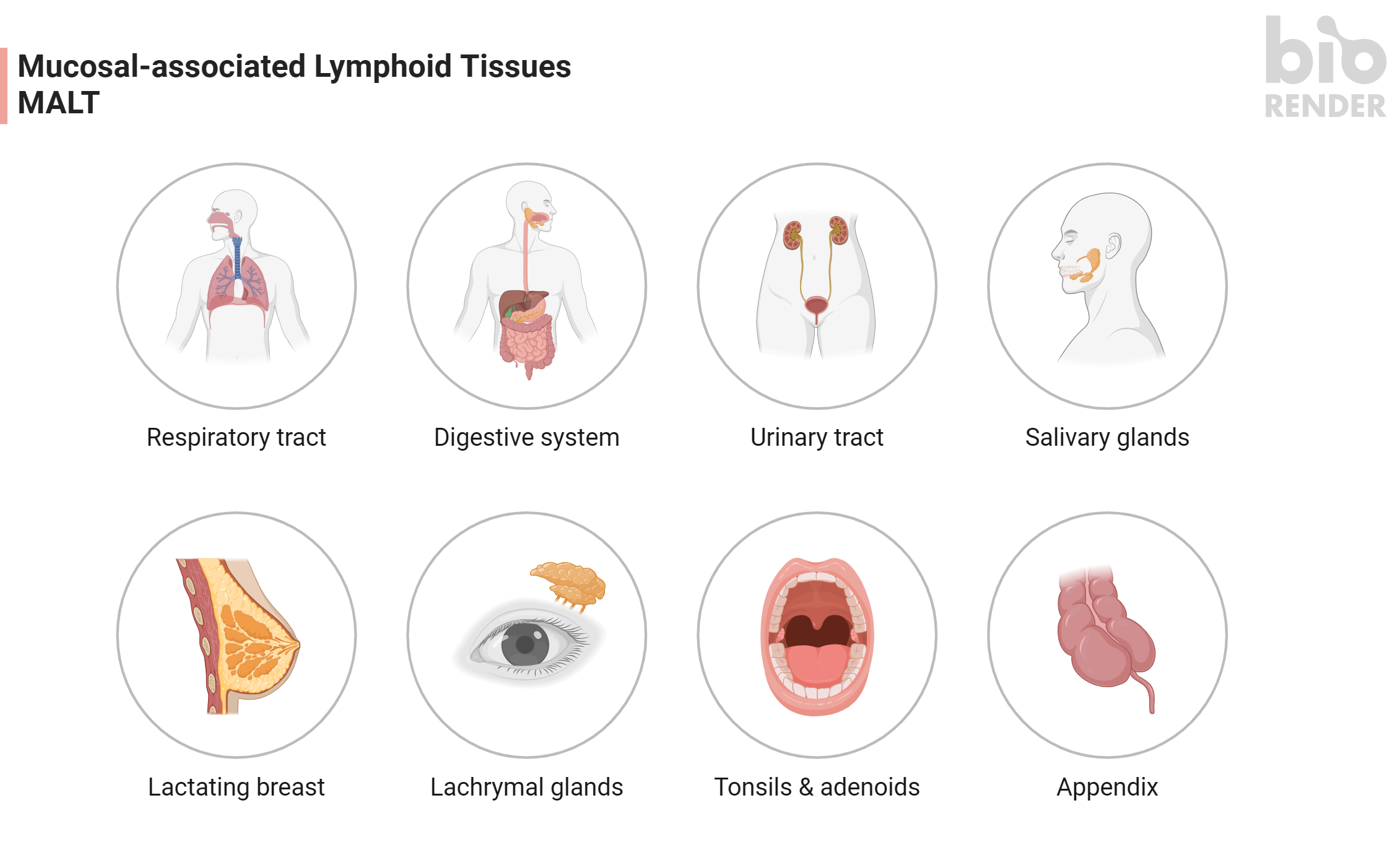
Diffuse MALT in the lamina propriascattered everywhere along the tract
Throughout the entire gut, the lamina propria is studded with single lymphocytes and small lymphoid nodules. They are not visible as discrete labeled structures, but they are functionally what makes the gut wall bristle with immune cells. Every section of mucosa you've labeled contains MALT. MALT in the lamina propria — diffuse lymphoid tissue throughout the gut wall.
Peyer's patches — the ileum's specialtythe largest organized GALT
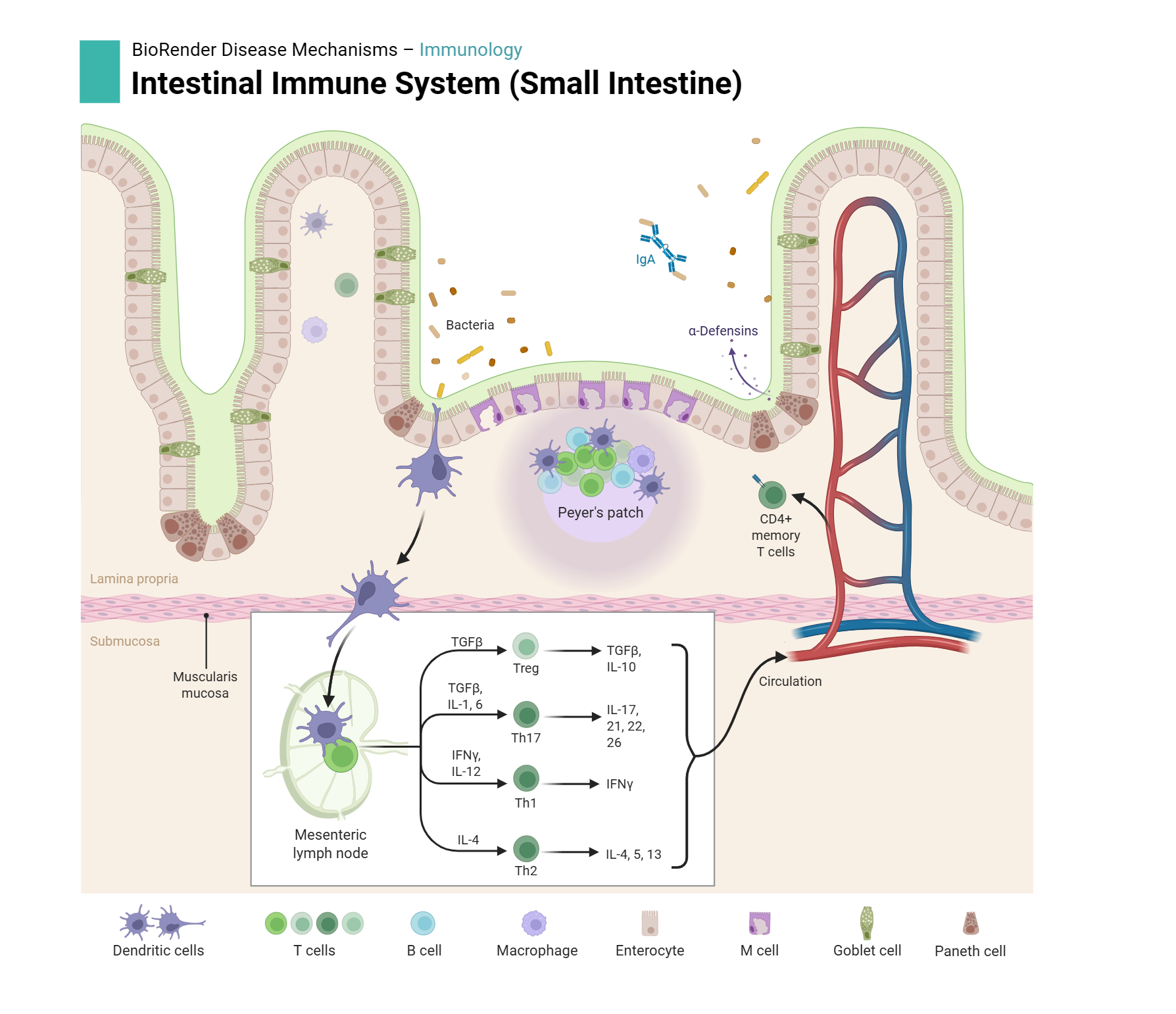
In the ILEUM, lymphoid follicles cluster into large, organized aggregates spanning the lamina propria AND the submucosa. The overlying epithelium has flat-topped M cells (instead of villi+microvilli) — they "sample" antigens from the lumen and hand them to dendritic cells inside the patch. Activated B cells leave the patch, mature into plasma cells, and secrete IgA back into the gut lumen. This is the body's main way of policing intestinal microbes without full inflammation.

Note: the muscularis mucosae is INTERRUPTED beneath each patch — necessary so cells can move between mucosal and submucosal halves of the follicle. Peyer's patch reference image.
The appendixessentially a Peyer's-patch-shaped organ
A thin extension off the cecum, packed wall-to-wall with lymphoid follicles. Functionally, it's basically a Peyer's-patch-style GALT structure with its own wall. Recent evidence also suggests the appendix is a "reservoir" for commensal gut bacteria — recolonizing the gut after diarrheal illness or antibiotics.

Clinical aside: patients with selective IgA deficiency get more frequent gut and respiratory infections. Patients on long-term steroids have shrunken Peyer's patches and similar problems. Nurses see this every day on transplant and rheumatology services.

INTERACTION

Click to reveal — Peyer's patch structures

🚧 Under construction — Peyer's-patch click-to-reveal coming soon. 🚧
H5P PLACEHOLDER — Bonus Question Set: Immunity
Embed the bonus 6-question Immunity set here once published.
[h5p id="DIGESTIVE-IMMUNITY-BONUS"]
[ INSERT MICROGRAPH — PALATINE TONSIL ]
Stratified squamous lining + deep crypts diving into lymphoid follicles.
[ INSERT MICROGRAPH — APPENDIX ]
Cross-section showing lymphoid follicles ringing the lumen.
[ INSERT MICROGRAPH — PEYER'S PATCH IN ILEUM ]
Large lymphoid follicles spanning lamina propria + submucosa under reduced villi.
CONFIRMATION

Quick self-check

Where in the gut are Peyer's patches concentrated?
Peyer's patches are characteristic of the ILEUM. They span the lamina propria and submucosa.
Which antibody class do GALT B cells dump into the gut lumen?
Dimeric IgA is transported across the epithelium and dumped into the lumen, where it neutralizes antigens before they reach the wall.
Which cells in the epithelium ABOVE a Peyer's patch sample antigens from the lumen?
M cells are flat (no microvilli) and pull antigens up from the lumen, handing them to dendritic cells inside the patch.
Why is the muscularis mucosae INTERRUPTED beneath a Peyer's patch?
The patch spans both layers; the muscularis mucosae must be discontinuous so cells in both halves can communicate.

Quick decision card — when in doubt at the scope

If you put an unknown slide on the scope, ask three questions in this order:

1. What is the lining? Stratified squamous = esophagus or anal canal. Simple columnar = stomach, small intestine, or colon.

2. If simple columnar, are there villi? Yes = small intestine. No = stomach (look for pits + parietal/chief cells) or colon (flat surface, many goblet cells).

3. If small intestine, do I see Brunner's or Peyer's? Brunner's (submucosal mucous glands) = duodenum. Peyer's (large lymphoid follicles) = ileum. Neither = jejunum.

For accessory glands, look for the signature features: salivary = mixed acini; pancreas = acini + pale islet; liver = hexagonal lobule with central vein; gallbladder = tall folds with no submucosa.