Roots, Rami, and Plexuses
Marge knows something is crushed at L5. But what IS a nerve root? And how does a single root control an entire movement?
THE CABLES BEHIND THE CUT

| After my first surgery, the neurosurgeon came to my hospital bed and told me which nerve root had been compressed. He said “L5” the way a mechanic says “cylinder four” — like I was supposed to know what that meant. I didn’t. I just knew my foot wouldn’t pick itself up off the floor. What I’ve learned since is that the spinal cordThe central nervous system structure that relays signals between the brain and body. doesn’t connect to the body directly. It sends out pairs of cables — nerve roots — that slip out between the vertebrae and branch into specific territories. Each root has an address: a strip of skinThe body’s largest organ, providing protection and regulation. it feels (a dermatomeA specific area of skin supplied by a single spinal nerve.) and a set of muscles it moves (a myotome). Compress the wrong root and a very predictable piece of you stops working. In my case, that piece was the muscle that lifts the foot. The L5 root runs it. The L4/L5 disc was sitting on that root like a truck tire on a garden hose. No signal getting through, no foot going up. |
Let’s trace the wiring from cord to foot — and figure out why one crushed root can drop an entire gait.
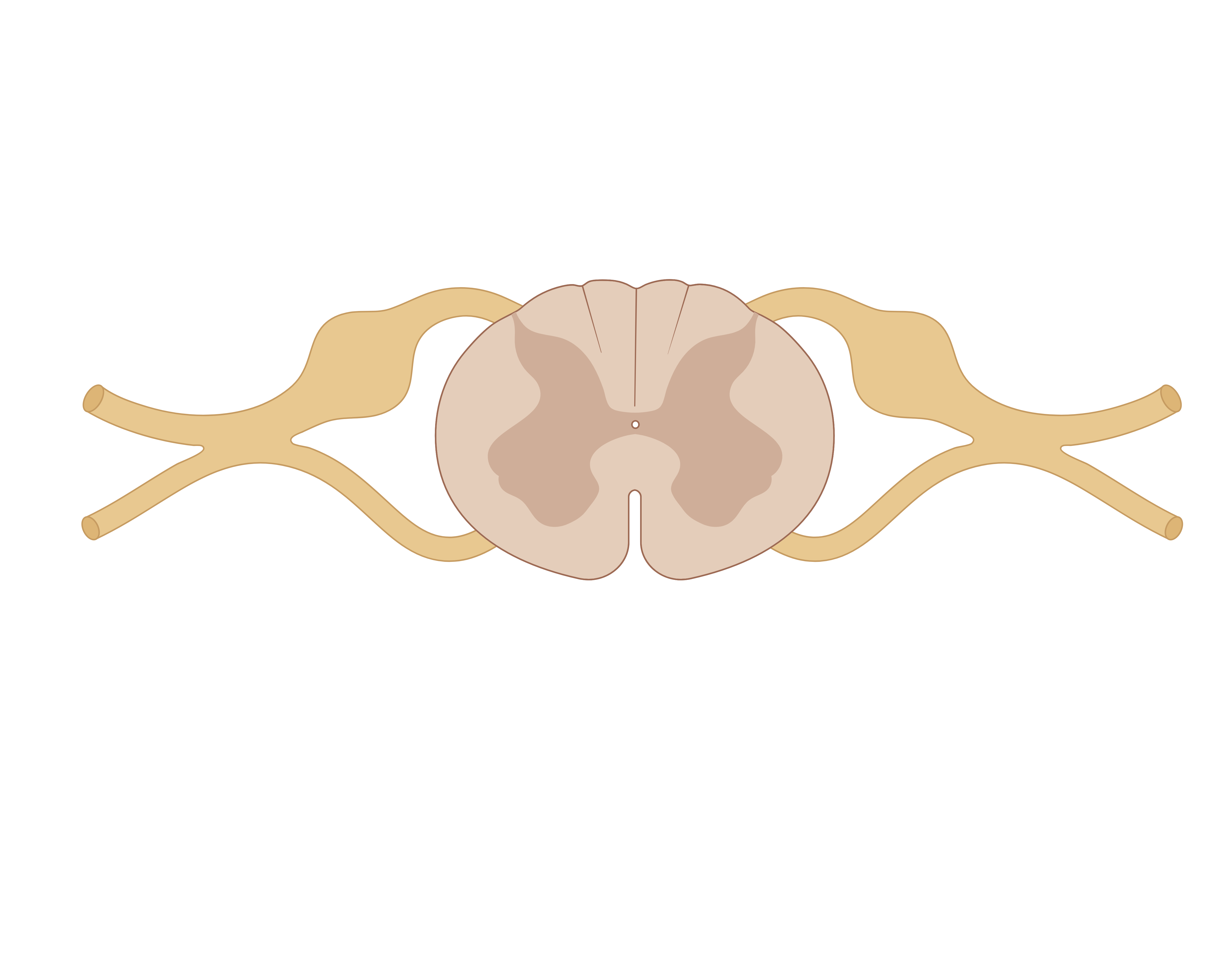
You’ve met the meninges(singular: meninx) – Protective membranes surrounding the spinal cord and brain.. Now zoom in further — past the protective layers, right to the surface of the cord itself. What you’ll see are cables exiting in pairs: one sensory, one motor. They merge, split again, and fan out to every square inch of your body. Watch how it works, then we’ll trace Marge’s specific wiring.
🔌 Activity 1 · Trace the Signal
Six structures, one cross-section. Hover over each hotspot to find where sensory signals enter, where motor signals exit, and where the nerve splits into its branches. Think of it as tracing Marge’s foot drop from cord to skin.
Watch time: ~6–8 minutes. Multiple-choice questions will pop up as you go.
🧩 Activity 2 · Build the Nerve Pathway
Seven labels, one pathway. Drag each structure to its correct position on the diagram and build the nerve pathway from spinal cord to periphery. The order matters — signals don’t skip stops.
Activity 3 – Anatomy Gauntlet
Seven cards, seven structures. Each one shows you an anatomical image — can you name the structure before you flip? Use the hint if you’re stuck. The back tells you what it is AND what it does.
| TO BE CONTINUED… You’ve traced Marge’s wiring from the cord to the skin and back. You know the L5 root powers dorsiflexion, and you know the L4/L5 disc crushed it. But the L5 ventralRelating to the front or belly side of the body. horn motor neuron didn’t decide on its own to fire. It got an order. That order came down from the motor cortex, traveling through the white matterThe outer portion of the spinal cord made of myelinated nerve fibers that transmit signals. of the cord like a signal down a highway. If roots and rami are the off-ramps, then the tractsBundles of nerve fibers in the CNS that carry signals between brain regions. running inside the cord are the interstate system. Sensory signals ride one set of highways up to the brain. Motor commands ride another set back down. Each highway has a name, a route, and a very specific job. The next time Marge’s neurologist taps her Achilles tendon and gets no reflex, you’ll know which highway carried the sensory signal up — and which highway should have carried the motor response back down. → Continue to Chapter 4: Tracts and Pathways |

From Marge’s Chart: 5 Questions
You can see the structures, trace the pathway, and name every piece. Now put it all together — five case-study questions that ask you to think like Marge’s neurosurgeon. Mixed formats: multiple choice, true/false, ordering, fill-in-the-blank. Every question traces back to Marge.
You’ve traced the signal from cord to foot and back. You know which root is compressed and why. But here’s a question the roots can’t answer: how does the brain know about the foot drop? How does the motor command get from cortex to ventral horn in the first place? The answer is inside the white matter — and that’s Chapter 4.
Explore More on the Spinal Cord
List of terms
- spinal cord
- skin
- dermatome
- meninges
- ventral
- white matter
- tracts