Time To Read
Date Last Modified

Biceps brachii
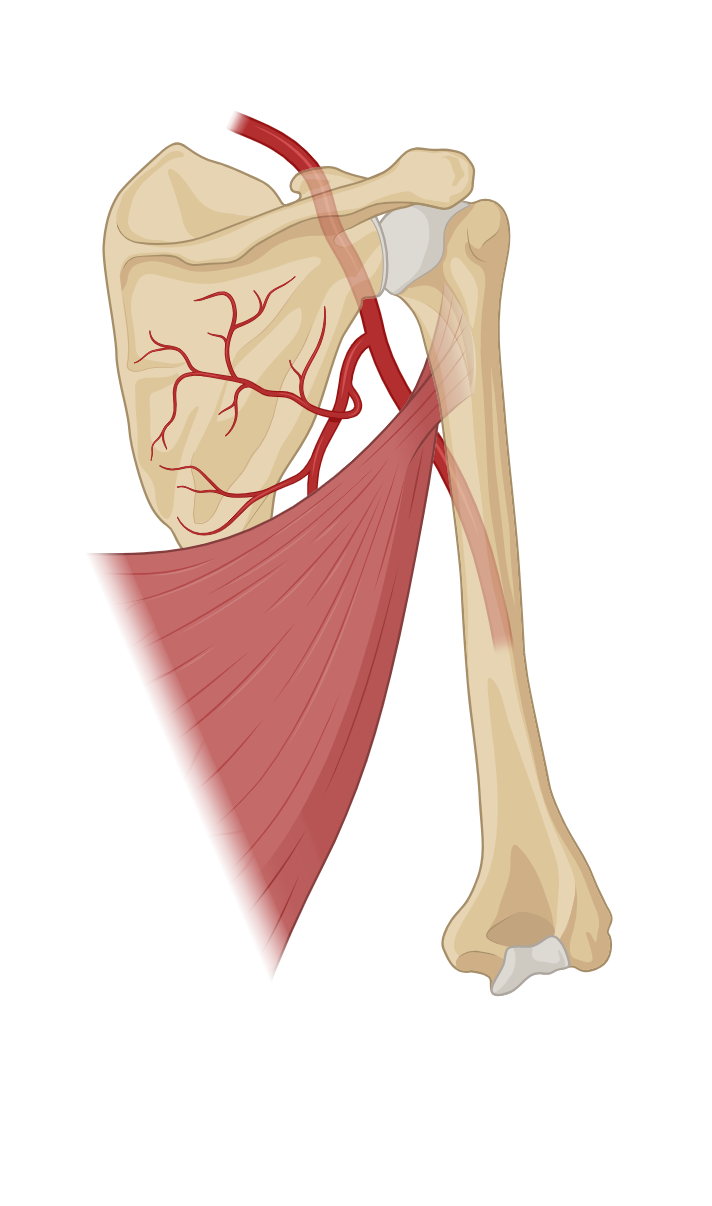
The biceps brachiiFlexor / Supinator Front of upper arm; bends elbow and turns palm upward. muscle is a two-headed muscle, as the name “biceps” suggests.

Photography, text, and labels by Rob Swatski, Assistant Professor of Biology, Harrisburg Area Community College – York Campus, York, PA.
Biceps brachii Origin
Long Head: The long headRounded proximal end that fits into the acetabulum of the hip bone. of the biceps originates from the supraglenoid tubercle of the scapulaTriangular “shoulder blade” on posterior thorax; connects clavicle and humerus..
Short Head: The short head of the biceps originates from the coracoid processHook-like projection anterior to the acromion; attachment for muscles of the arm and chest. of the scapula.
Lateral Head: The lateralAway from the midline of the body. head originates from the posterior surface of the humerusLong bone of the upper arm; articulates with scapula at shoulder and radius/ulna at elbow., above the radial groove.
Medial Head: The medialToward the midline of the body head originates from the posterior surface of the humerus, below the radial groove.
Biceps brachii Insertion
The two heads of the biceps merge to form a single muscle belly. This muscle belly inserts onto the radial tuberosityRough bump just below head for biceps muscle attachment.. The radial tuberosity is a bony protuberance on the radiusLateral forearm bone (thumb side); rotates around ulna during pronation/supination. bone in the forearm. Additionally, the biceps brachii inserts into the deepAway from the surface of the body. fascia of the forearm via the bicipital aponeurosis.
Biceps brachii Actions
Assistance in Shoulder Flexion
Supination of the Forearm
Elbow Flexion
Interactive Materials
Use this 3D Viewer to Explore the Muscles of the Upper Body
“Open3DModel – Upper limb – English labels” by Open3D project, Jan Kooloos, RadboudUMC, Eungyeol Lee, LUMC et al, license: CC BY-SA
Identify More Muscles
Link to more Muscle Identification
Upper Arm Muscles
Forearm Muscles
Calf Muscles
Anterior Thigh Muscles
Posterior Thigh Muscles
Knee Structures
Chest Muscles
Back Muscles
Abdominal Muscles
Neck Muscles
Head Muscles
List of terms
- biceps brachii
- anatomy
- head
- scapula
- coracoid process
- lateral
- humerus
- medial
- radial tuberosity
- radius
- deep