General Spinal Cord Anatomy
What exactly is the spinal cord, where does it live, and why does it matter that Marge’s damage is at L4/L5?
The Accident

| “What happened?” Marge asked the EMT as he cut off her seatbelt. A tree had just introduced itself to her car’s front end with excessive enthusiasm, and now her vertebral column was having opinions about it. The ER took some nice pictures, found nothing broken, and sent her home with the medical equivalent of “walk it off.” Spoiler alert: it did not walk off. Over the next year, Marge’s body would file a series of increasingly urgent complaints: a foot that wouldn’t lift, pain that burned like a live wire down her leg, and a reflex test that came back silent. Every one of those symptomsSubjective experiences reported by the patient (e.g., nausea, fatigue). traces back to the anatomyThe study of the structure of the human body. you’re about to learn. But first — before we can figure out what went wrong, you need to know what you’re looking at. What exactly IS the spinal cordThe central nervous system structure that relays signals between the brain and body.? Where does it live? Where does it end? And why does it matter that it ends where it does? |
A low-speed fender-bender. A clean X-ray.
A pat on the back and a prescription for muscle relaxers. Marge was told she was fine.
She was not fine.
Put Yourself in the ER
Imagine Marge is in front of you right after her accident. To reason about what’s injured and what’s not, you need to know this roadmap cold — where the cord starts, where it ends, where it’s thickest, and what picks up below it. Click through every hotspot on the diagram to build your mental map of the cord from top to bottom.
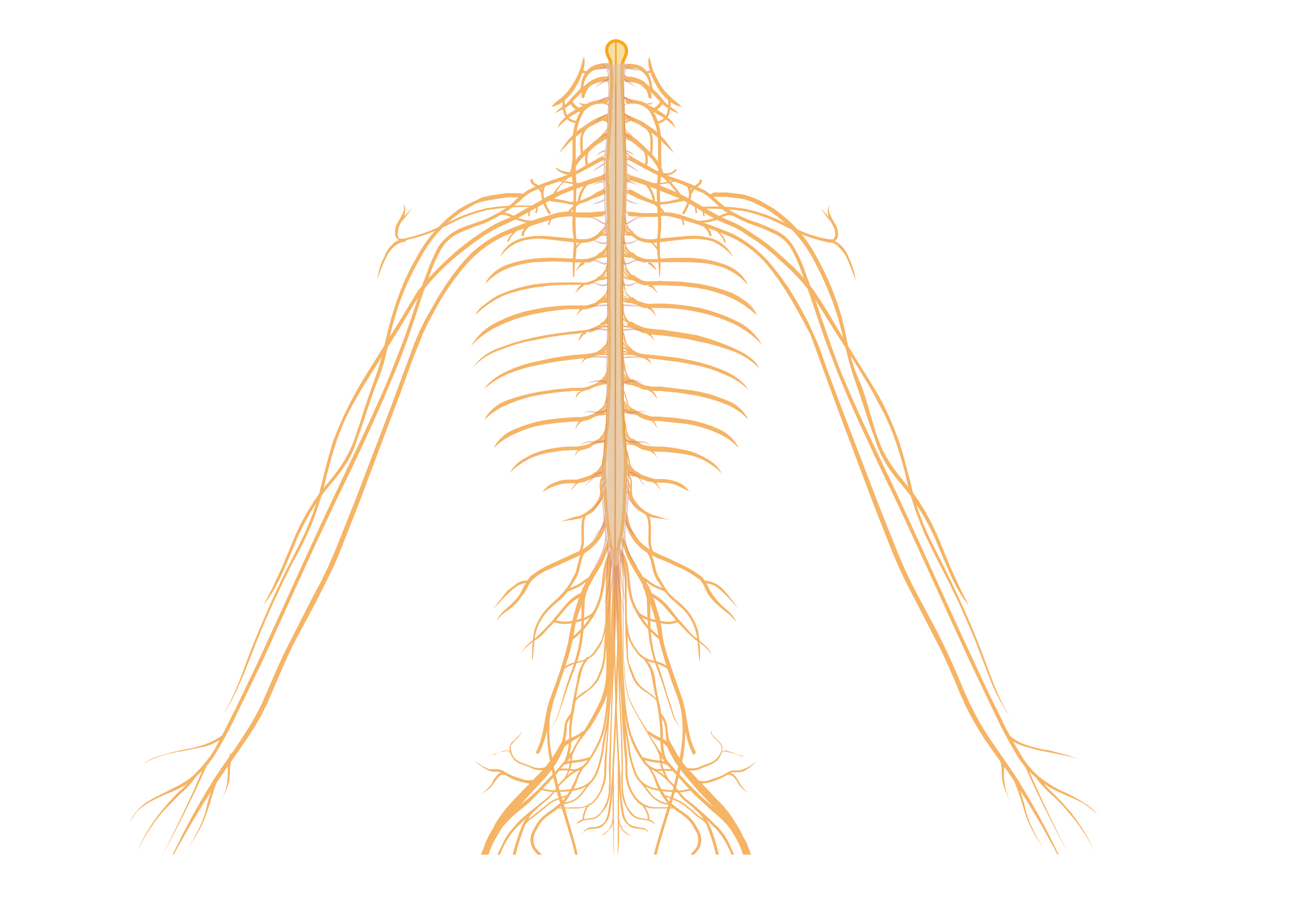
In this video, you’ll meet Marge and learn the foundational anatomy the ER team should have been thinking about — the difference between the spinal cord and the vertebral column, where the cord actually ends (hint: not where you’d guess), and why certain regions of the cord are more vulnerable than others. By the end, you’ll know enough to spot the mistake the ER made.
Watch time: ~10 minutes. Questions will pop up as you go — they’re not graded, just checkpoints to keep you engaged.
One Month Post Accident
One month after the accident, Marge’s left foot stopped lifting off the ground.

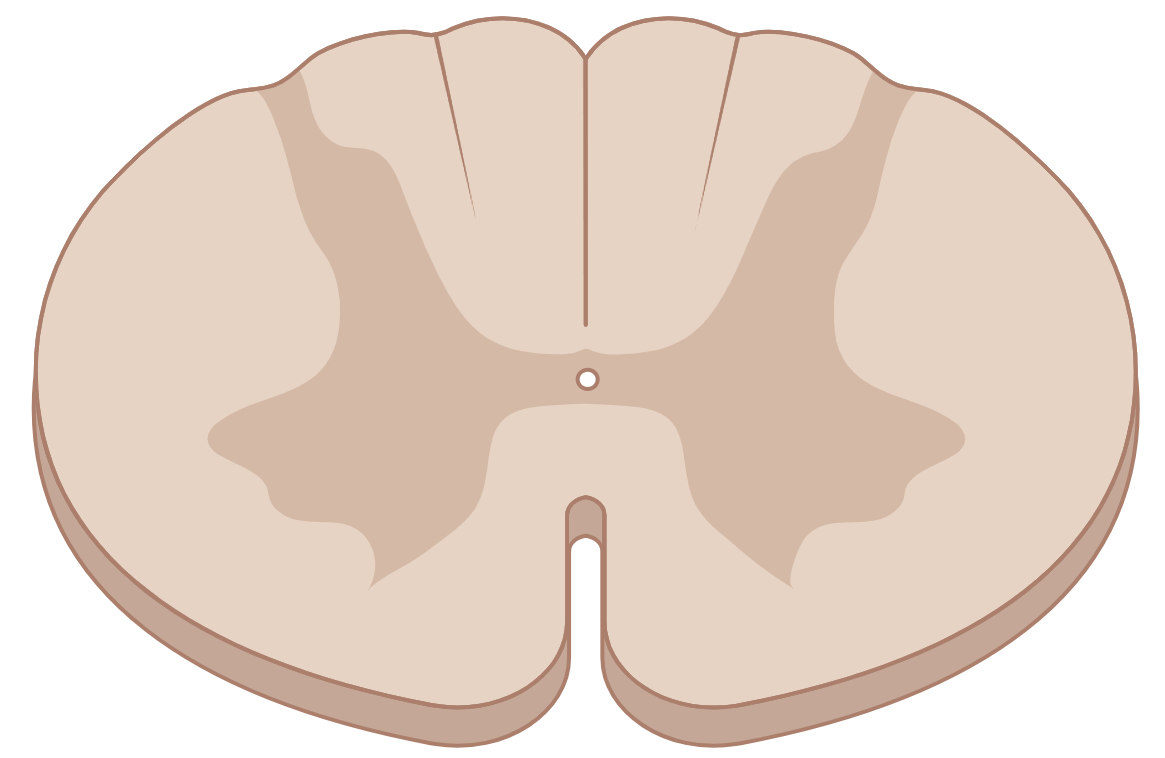
That single symptom — foot drop — is a flashing neon sign pointing to a specific nerve root at a specific spinal level. But to read that sign, you need to understand what’s inside the cord: the white matterThe outer portion of the spinal cord made of myelinated nerve fibers that transmit signals. highways that carry signals up and down, the gray matterThe inner portion of the spinal cord composed mostly of neuron cell bodies and synapses. processing centers where reflexesAutomatic responses to stimuli. happen, and the landmarks that let you orient yourself on any cross-section.
This video picks up where Part A left off. By the end, you’ll be able to look at a spinal cord cross-section and immediately know which side is front, which is back, and what each zone does. You’ll also learn why the cord is basically built like a candy bar — white chocolate shell outside, dark chocolate center inside.
Watch time: ~10 minutes. Same deal — multiple-choice questions along the way.
Every time we talk about spinal cord pathology for the rest of this module, you’ll be staring at a butterfly-shaped cross-section. Drag the labels where they belong — get this down and every future chapter gets easier.
You’ve explored the map. You’ve labeled the cross-section. Now prove it — eight cards, eight truths. Flip through as fast or as slow as you need. Stuck? Tap the hint button before you peek at the back.
| Six weeks after the accident, Marge’s doctor ordered an MRI. The images showed two herniated discs — at L4/L5 and L5/S1 — bulging into the space where nerve roots should be floating freely. But before a surgeon could even think about removing those herniations, they’d need to navigate through three protective layers wrapped around the spinal cord and its nerve roots. Cut through the wrong one in the wrong place and you’ve got a cerebrospinal fluid(CSF) – A fluid that cushions and nourishes the brain and spinal cord. leak. Miss one and you haven’t reached the problem. What are those three layers? What’s between them? And which space did the disc herniate into? → Continue to Chapter 2: “The Armor” |

Four questions stand between you and Chapter 2. You’ve watched the video, explored the cord, labeled the butterfly, and flipped the cards. Now use what you know to explain what’s happening to Marge.
Explore More on the Spinal Cord
List of terms
- symptoms
- anatomy
- spinal cord
- white matter
- gray matter
- reflexes
- cerebrospinal fluid