THE IN-BETWEENERS ◆ ISSUE #10 ◆ SERIES II: THE BONE DIVISION

Captain Concrete
Compact bone · he / him
“I do not bend.”
POWER: The hardest thing in your body. Will not bend, will not budge.
WEAKNESS: He had to build plumbing to every single room just to stay alive.
FIBERS: Collagen (type I), mineralized. That’s what stops him shattering.
SECRET IDENTITY: The dense outer shell of every bone you own.
Bone tissue (osseous tissue) is the hardened connective tissue of the skeleton. Its matrix holds calcium salts (hydroxyapatiteA mineral form of calcium phosphate giving bone its hardness.), which make it hard. Compact bone is organized into osteonsThe structural unit of compact bone, consisting of concentric lamellae around a central canal..
Hard Exterior. Needs Constant Plumbing.
Where he lives, what he does, and the one thing he can’t do
Where he lives
- The axial skeleton: skull, vertebrae, ribsCurved bones forming the rib cage; articulate with thoracic vertebrae and most with the sternum., sternumFlat bone forming the center of the chest; anchor for ribs and clavicles. Appears as a vertical dagg
- The appendicular skeleton: the limbs and their girdles
- The outer shell (bone collar) of long bones, around a core of spongy boneA porous bone tissue found inside bones, providing lightweight support.
- Both faces of flat bones, with spongy bone sandwiched between (diploëThe spongy bone layer sandwiched between compact bone in flat bones.)

His powers
- Structural support for the whole body
- Protects organs: skull, rib cage, spineProminent ridge on the posterior scapula dividing it into supraspinous and infraspinous fossae.
- Muscle attachment for movementA fundamental property of life involving motion of the body or its parts.
- Houses bone marrow and stores calcium
His weakness
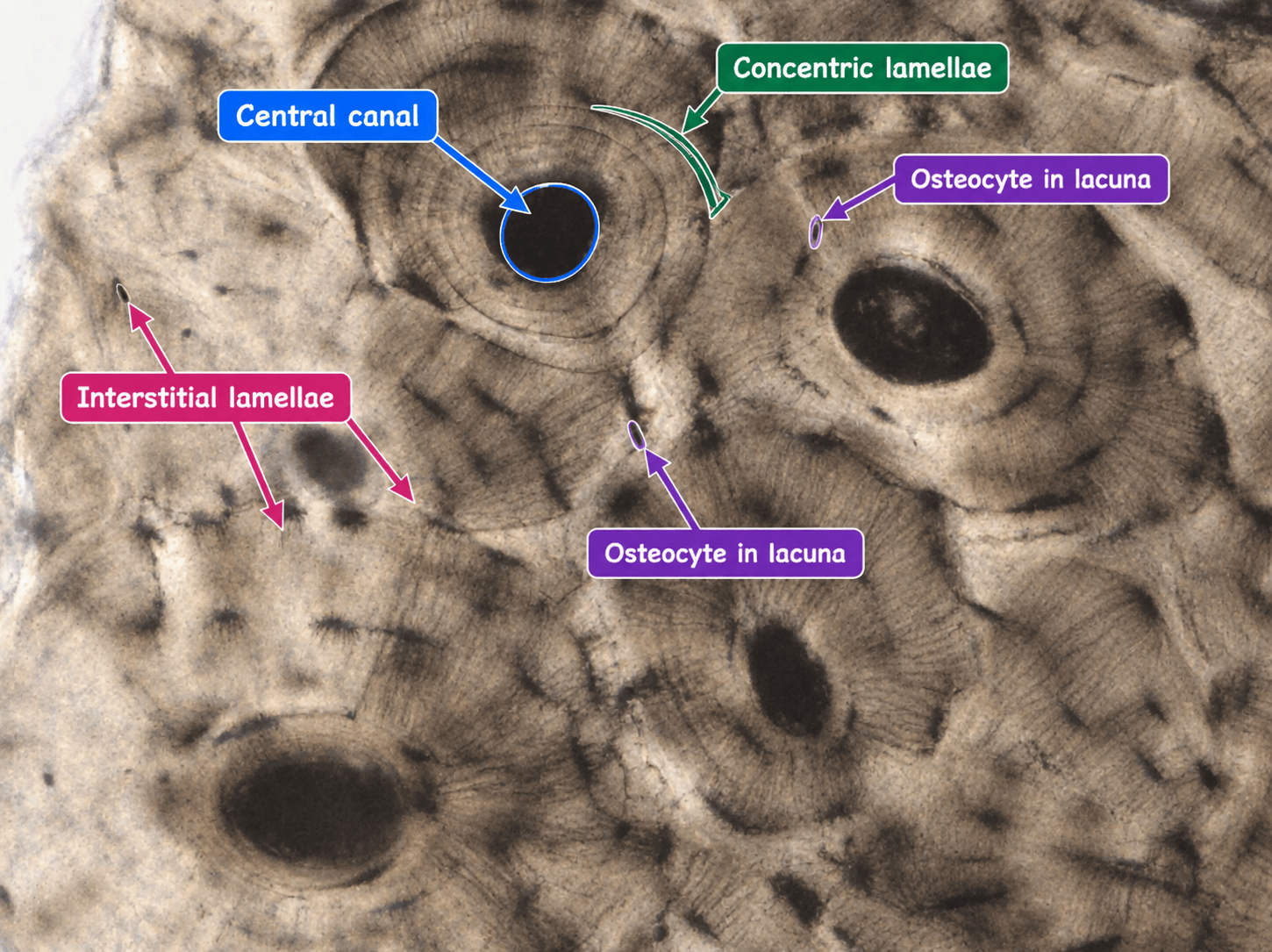
Solid rock can’t let nutrients diffuse through. So every osteon needs a central canalA hollow canal in an osteon containing blood vessels and nerves. with an artery, a vein, and a nerve, and tiny canaliculiTiny channels that connect osteocytes, allowing communication and nutrient exchange. reaching every trapped osteocyte.
Osteons are pillars: superb under force from one direction, weaker from others.
Every weakness is the structure.
Three Roommates, One Very Hard House
Three kinds of bone cell, one very hard matrix
The crew: cells
Osteoblasts Bone-forming cells that secrete osteoid. build bone, secreting osteoid. OsteocytesMature bone cells that maintain bone tissue. are osteoblasts trapped in their own matrix, living in lacunae and connected by canaliculi. OsteoclastsBone-resorbing cells that break down bone matrix. are large, multinucleated cellsThe basic structural and functional units of life. that dissolve bone (resorption).
The fibers
Mostly type I collagenA structural protein in the dermis that provides strength and elasticity.: the flexible part of bone, in a mesh that resists bending and twisting. Each concentric lamellaRings of bone matrix surrounding the central canal in an osteon. runs its collagen in a different direction.
The matrix
About two-thirds hydroxyapatite (calcium salts, the hard part) plus collagen and waterThe universal solvent essential for life.. Flexible and strong. The cells themselves are only about 2% of bone.
Bullseye Energy
Real slides. Find him in every one.
ID HINT: A bullseye: concentric rings (lamellae) around a dark central canal, with lacunae between the rings.
Exhibit A

Exhibit B

Exhibit C

Micrographs: University of Michigan Histology, licensed under CC BY-NC-SA 3.0.

Stalk Their Actual Profile
Drive the microscope yourself
Virtual slide: ground bone
The purple tab on the right opens a panel with information and links.
Prove You Were Actually Paying Attention
Prove you can spot him
Mission 1: Discover the features of bone
Mission 2: Bone quick check
Videos Nobody Asked You to Watch (Watch Them)
Inside His Walls (He Has a Lot of Walls)
The functional unit of bone
The pillar
Each osteon is a pillar of concentric lamellae around a central (Haversian) canal carrying an artery, a vein, and a nerve. Like porch columns, pillars hold up enormous weight from above but aren’t built for a hit from the side.
The plumbing
Osteocytes trapped between the lamellae still need glucoseA simple sugar that is the main source of energy for cells. and oxygen. Canaliculi, tiny canals through each lamella, link every osteocyte to its neighbors and to the central canal.
The filler
Circumferential lamellaeOuter layers of bone tissue that encircle the entire bone. wrap the whole bone. Interstitial lamellae fill the gaps between osteons, like someone saying “don’t forget to fill in the spaces between the pillars.”
Would Never Be Seen With These Two
Students confuse him with these two. Here’s how to tell.
The Glider

Hyaline cartilageA flexible connective tissue found in joints, the ear, nose, and rib cage. Cartilage can be of three. At low magnification both show cells in lacunae. Only bone has rings around a central canal.
The Lattice

Spongy bone. Same matrix, chemically identical. Concrete is solid osteons; the Lattice is struts with marrow between them.
List of terms
- hydroxyapatite
- osteons
- ribs
- sternum
- spongy bone
- diploë
- spine
- movement
- central canal
- canaliculi
- Osteoblasts
- Osteocytes
- Osteoclasts
- cells
- collagen
- concentric lamella
- water
- glucose
- Circumferential lamellae
- cartilage