Time To Read
Date Last Modified
Pl. II · FAM. HAURIENTIDAE
Hauriens moniliformis var. hormosirae
the string of beads · collecting lymphatic vessel
The plate
The specimen, drawn
Pl. II

Neptune’s necklace as it was drawn, with a collecting lymphatic vessel in long section below it and one of its valves in the circle.

Habitat & range
Where it lives
Body map

Alongside the veins, from every limb and organ back toward the root of the neck.
Range
- Beside the veins and arteries of the limbs, in the same connective tissue sheath.
- Running into and out of every lymph node (Pl. III): several afferent vessels in, one or two efferent vessels out.
- Joining into trunks, and the trunks into two ducts: the thoracic duct, which drains most of the body, and the short right lymphatic duct.
- Both ducts empty into the great veins at the base of the neck, which is where the three litres go back to the blood.
Collection record
- Add your slide numbers here.
Niche
What it does for a living
Move lymph uphill with no heart behind it. The capillaries (Pl. I) drain into collecting vessels, and these have a real wall: an endothelium, a thin layer of smooth muscle, a little connective tissue outside. All three layers together are thinner than the wall of a vein the same size. What a collecting vessel has in abundance is valves. They are every few millimetres, far closer together than in any vein, and each is a pair of thin leaflets with their free edges pointing downstream. The stretch of vessel between one valve and the next is called a lymphangion, and it behaves like a tiny heart chamber: when it fills, its smooth muscle contracts, the valve behind shuts, the valve ahead opens, and the lymph moves on one segment. Anything that squeezes the vessel from outside helps too: a contracting muscle, a pulsing artery in the same sheath, the pressure changes of breathing. Because the vessel bulges between valves and pinches at each one, a full lymphatic looks beaded. Flow is slow, a few litres a day, and it stops if the limb is still, which is why a leg swells on a long flight.
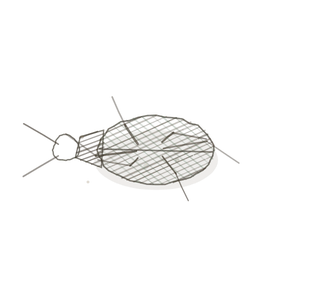
field collected specimen
How to know it on sight
- A thin wall round a wide, irregular lumen: thinner than a vein of the same calibre, and much thinner than the artery beside it.
- Valves, and many of them. Two delicate leaflets meeting in the lumen, often several in one field.
- Pale contents: a faint pink wash of protein and a few lymphocytes. Never packed with red cells.
- Usually travelling with a small artery and vein. Of the three, the lymphatic is the one that looks empty.

Specimen 1

An arteriole and its companion venule in fat. Vessels travel in company; a lymphatic is the third member of the group, the thinnest-walled, and usually collapsed.
Specimen 2

Where the vessels are going: a small lymph node lying in fat beside larger vessels. Afferent lymphatics enter round its curved side.
Specimen 3

A valve in a vein, drawn, from Ordo Vasa. The same two-leaflet door; a lymphatic has far more of them in far less wall.


People keep calling her by the wrong name
Look-alikes
Two blood vessels with thin walls. The contents settle it before the wall does.
A small vein

A small artery and vein — the vein’s wall is thin too, but there is a visible layer of muscle in it, and the lumen holds red cells.
A venule

A venule — thin and irregular, but with red cells inside and no valves at this size.
Examine it yourself
The virtual slide
This slide is mesentery, with a lymph node in it. Find the node, then search the fat round it for thin-walled channels with nothing red inside. Follow one and look for a valve: two fine leaflets angled the same way. Then find a small artery and vein near it and compare all three walls.
Virtual slide courtesy of Histology Guide.
YOur missions
Field Notes for Future Missions
Mission 1: label the vessel
Mission 2: quick check
Field notes
Why this organism
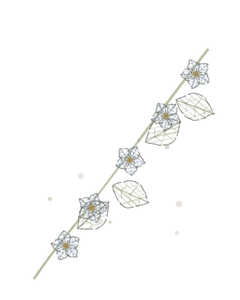
Neptune’s necklace is a seaweed of rock platforms on the far side of the world, in Australia and New Zealand, and it looks exactly like its name: strings of hollow olive beads, each about the size of a marble, joined one to the next by a short narrow neck. The beads are full of water. The chains fork and fork again, and at low tide they lie over the rock like spilled jewellery. It is here for its outline. A collecting lymphatic vessel that is full of lymph has the same one: swell, pinch, swell, pinch, a bead for every segment and a narrow neck wherever there is a valve. Anatomists who first injected these vessels with mercury drew them as strings of beads, and the word they used, moniliform, means precisely that. If you see a thin-walled vessel on a slide that bulges and narrows along its length, you are almost certainly looking at a lymphatic. One honest difference, and it is a large one. Nothing flows along a chain of Neptune’s necklace. Each bead is sealed off from the next, and the water in it stays put. In a lymphatic every neck holds a valve, the valve opens one way, and the whole point of the chain is to pass its contents along it, bead by bead, toward the heart.
Next · Pl. III
Colans lymphae var. hydropsychae
the net in the current · lymph node.
In the wild · photograph to come.
Hop to:
← Epithelial Tissues: A Guided Journey
All plates — The Tissue Field Guide: Epithelium
Frontispiece Ordo Epithelia (main page)
Pl. I · Simple squamous
Pl. II · Simple cuboidal
Pl. III · Simple columnar
Pl. IV · Stratified squamous
Pl. V · Stratified cuboidal
Pl. VI · Stratified columnar
Pl. VII · Transitional
Pl. VIII · Pseudostratified columnar
Epithelial Identification Game
All Modules
- Anatomical Language, Membranes & Homeostasis
- Just Enough Chemistry
- The Cell & Its Transport
- Making Cells & Proteins
- The Integumentary System
- The Skeletal System
- The Muscular System
- Nervous Tissue & the Senses
- The Spinal Cord
- The Brain & the Blood–Brain Barrier
- The Autonomic Nervous System
- The Special Senses
- The Endocrine System
- Blood
- The Heart
- Blood Vessels
- The Digestive System
- The Respiratory System
- The Urinary System
- Fluids, Electrolytes & Acid–Base Balance
- The Reproductive System
- The Immune System